
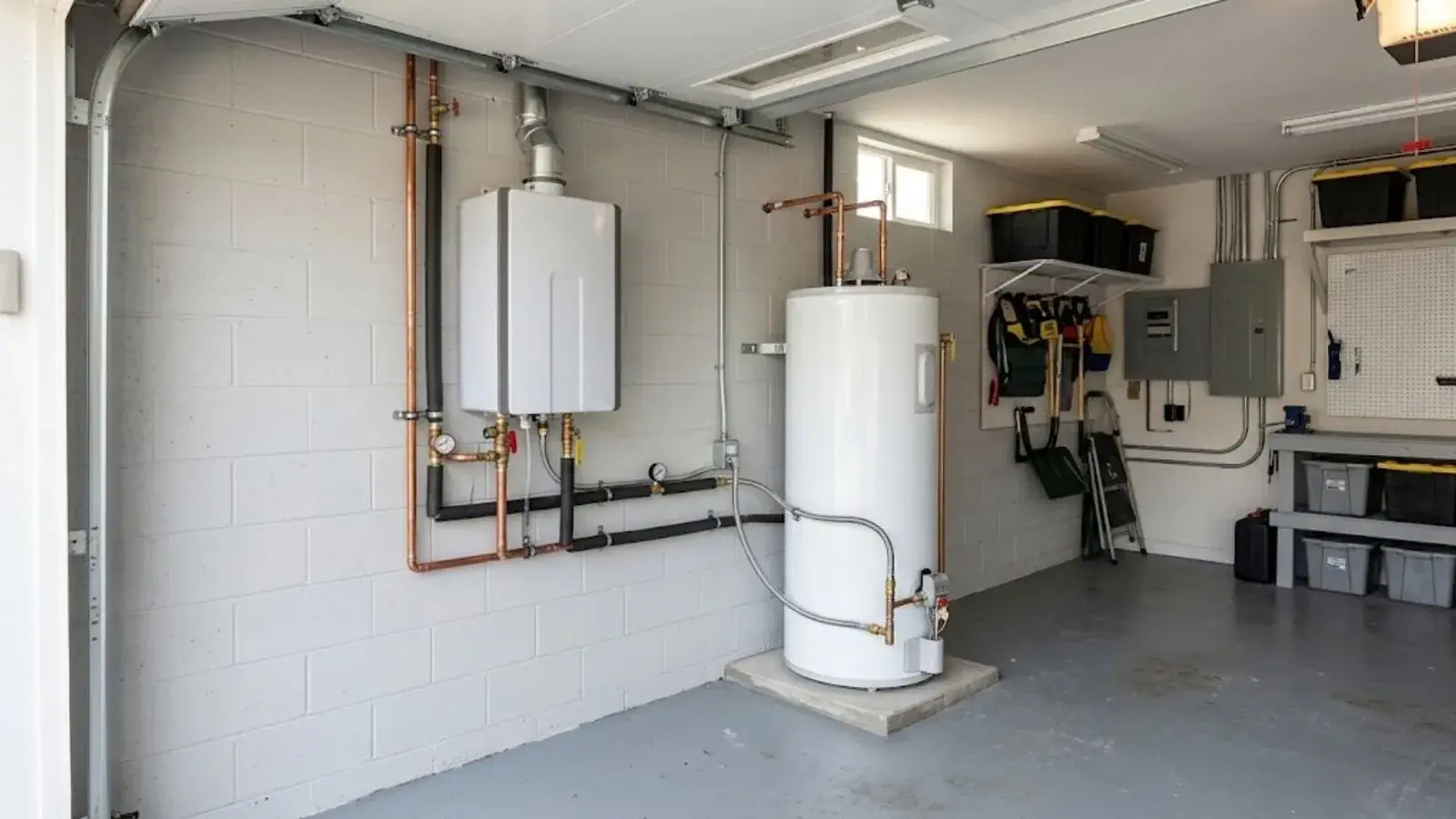
How a tankless unit heats water
When you open a hot tap, a flow sensor tells the unit to fire. Gas burners or electric elements heat the water as it passes through a heat exchanger, and the heater shuts off when the tap closes. There is no stored supply, so the limit is how much water the unit can heat at once, not how much it holds.
That limit is called the flow rate rise. A unit that handles one shower may struggle with two showers and a dishwasher at the same time. We size to your busiest moment, not your average day. If the heater has stopped working altogether, call about water heater repair for a fast diagnosis.
| Factor | Tank | Tankless |
|---|---|---|
| Hot water supply | Limited by tank size, then recovers | Continuous, limited by flow |
| Space | Floor space and clearance | Wall mounted, smaller |
| Gas line and vent | Standard size | Often larger gas line, special vent |
| Maintenance | Tank flush, anode check | Periodic descaling flush |
| Install effort | Usually simple swap | Planned project with more work |
| Cold snaps | Indoors, protected | Depends on where it is mounted |
Gas line, vent and install requirements
A gas tankless unit burns a lot of fuel quickly, so the gas pipe often has to be larger than the one that served a tank. The meter, regulator and pipe run all matter. A licensed plumber measures the load and tells you whether a larger line is needed. South Jersey Gas handles the meter and utility side.
The vent is just as important. Condensing models use plastic pipe that exits through a side wall. We check termination distances from windows and doors, and the run length. Electric tankless units skip the vent but need heavy electrical service, which we check against your panel.
- Gas line capacity for the unit's full burner load.
- Vent route, material and exit location.
- Condensate drain for condensing models.
- Electrical outlet for the fan and controls, or a heavy circuit for electric models.
- Water pressure and flow at the fixtures you use together.
- Shutoff and service valves so the unit can be flushed.
Thinking about going tankless? Call and we will check the gas line and vent.
Call (609) 547-1417Flushing and descaling: why and when
Minerals in water can build up inside the heat exchanger. That slows heat transfer, raises temperatures inside the unit, and can trigger error codes. A flush circulates a descaling solution through the unit and then rinses it out. It needs service valves, so we install those on every new unit.
How often to flush depends on your water, so we do not set a number for you. Atlantic City Municipal Utilities Authority posts its water quality report, but it does not give a hardness figure, so test your tap or ask your utility if you want to know. Signs it is time include longer waits for hot water and changing temperature.
Error symptoms and the cold water sandwich
If the unit shows an error code, write it down, because the code points to ignition, exhaust, sensor or flow trouble. Many codes clear after a power reset and a flush. A cold burst between two hot ones is called the cold water sandwich. It happens when you shut the tap briefly and reopen it, and the water in the pipes cools.
| Symptom | Possible cause | What we check |
|---|---|---|
| Error code on display | Ignition, sensor or exhaust issue | Gas supply, vent, flame sensor |
| Hot water turns lukewarm | Scale on the exchanger or low flow | Flush, inlet screen, flow rate |
| Water goes cold mid-shower | Demand above the unit's rise | Fixture load and sizing |
| No hot water at all | Power, gas or safety shutoff | Breaker, gas valve, vent blockage |
We service the unit when a part can be fixed, and tell you when replacement is the better path. A failed unit with a dry floor is not an emergency, but a leak or gas smell is. For those, call the 24/7 line and read about emergency replacement.
Winter, freezing and where the unit goes
The airport has recorded a low of minus 11 F, and winter snowfall typically runs 12 to 18 inches. An indoor unit is shielded from that. An exterior unit relies on built-in freeze protection that needs power to work, so a long outage can matter. We talk through the location choice with you and avoid placing a unit where it cannot be serviced.
How a tankless project goes
- 1
Survey
We look at the gas line, meter, vent path, panel and water pressure.
- 2
Pick the unit
We match output to your busiest hot water use and your fuel.
- 3
Prepare
Gas line, vent and electrical changes are made before the unit is mounted.
- 4
Mount and connect
The unit goes on the wall with service valves and a condensate drain if needed.
- 5
Start up
We test ignition, flow and temperature, and show you the controls.
For the broader planning side, see water heater installation.
What affects the cost of a tankless water heater
Unit capacity
Higher flow models cost more than small ones.
Gas line upsizing
A longer or larger gas pipe adds materials and labor.
Venting
Side wall venting and condensate drains vary with the layout.
Electrical needs
Fan power, controls or heavy circuits change the scope.
Service valves and flushing
Valves, flush time and parts for scale or sensor trouble vary by unit.
Scale and age-related failures are maintenance issues that policies generally exclude. Ask your insurer what applies.
Tell us the model and symptoms and we give a clear price before work starts. Call (609) 547-1417.
Questions about tankless water heater in Atlantic City
It can if the unit or its pipes sit in an unheated space during a hard freeze or a power outage. Indoor units are better protected. Exterior models have heating elements for the internal parts, but they need power. We talk through placement before we set the unit.
It depends on your water and how much you use. We do not give a number without knowing your supply. Test your tap or ask your utility, and watch for longer waits or error codes. We install service valves so the flush is simple.
Write down the code, turn the power off for a minute, and turn it back on. If the code returns, call us with the model number. Codes can mean ignition, exhaust, sensor or flow trouble. For no hot water at all, the repair page explains our emergency visits.
Maybe not. Tankless units need a lot of gas at once, so the pipe from the meter often has to be bigger. We measure the run and the load at the survey and tell you before we quote. South Jersey Gas manages the meter side.
It saves floor space, but the vent and gas line can be harder in a multi-unit building. Check with building management on vent rules and gas supply. We compare options on the tank versus tankless table above and in person.
Yes. We serve Atlantic City and nearby towns, including Ventnor City. Call with the brand and model and we confirm what we can do. If a part is not available or a brand needs a factory tech, we tell you honestly.