
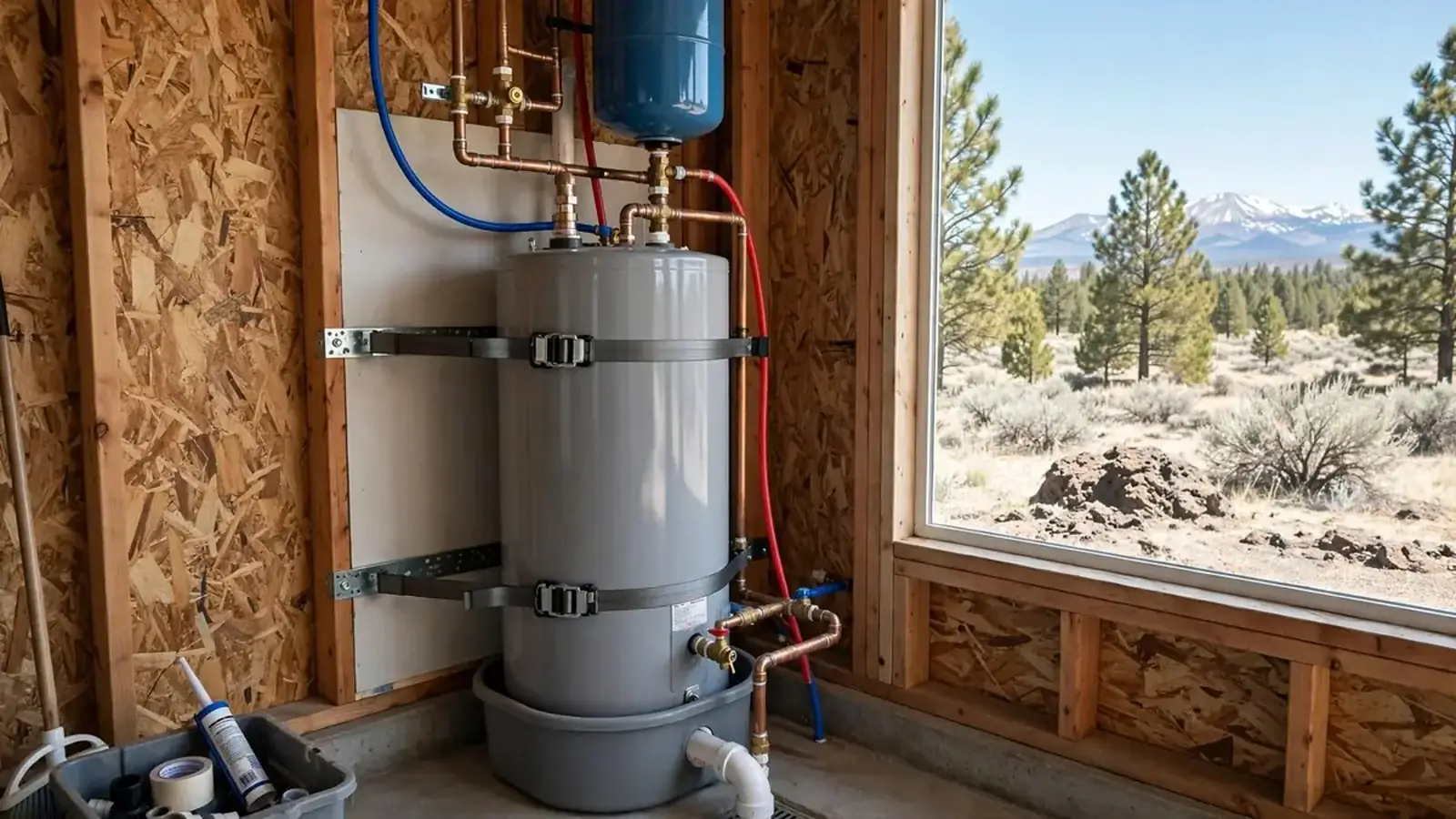
Start with where the heater will live
The location drives almost everything else. A heater needs floor space, service clearance in front, a way to carry it in, and a spot for water to go if it ever leaks. Garages, utility closets, basements where they exist, and mechanical rooms in multi-unit buildings each bring different limits.
Walk the space with a tape measure and take photos of the current heater, nearby shutoffs and the electrical panel. Moving a heater to a new spot means new pipe runs, a new vent or circuit, and more labor. Keeping the old footprint is the simplest path, and we say so when it is.
| Type | What the install needs | Things to settle first |
|---|---|---|
| Gas tank | Gas line, vent to the outside, combustion air, drain pan | Vent route and clearance |
| Electric tank | Dedicated circuit and breaker sized to the unit, drain pan | Panel capacity |
| Hybrid heat pump | Electric circuit, floor drain or condensate line, open air space | Room size and noise |
| Power-vent gas | Gas line, electric outlet, plastic vent to the side wall | Where the vent exits |
Venting and combustion air for gas units
A gas heater burns air from the room and pushes exhaust out through a vent. If the vent leaks or the room is sealed too tight, exhaust can spill back inside. We check vent size, slope, joints and termination, and we confirm there is enough air in the space. A power-vent model uses a fan and plastic pipe instead of a chimney.
If you smell gas at any time, leave the building on foot. Call South Jersey Gas at 1-800-582-7060 or 911 before anything else. We do not light or test a unit when a gas leak is suspected.
Safety around gas and oil fired heaters
- Keep a working carbon monoxide alarm near any gas or oil fired heater and near the bedrooms, and test it when the new unit goes in.
- Store paint, gasoline, solvents and household cleaners well away from the heater, since their vapors can ignite near a burner.
- Ask the installer to check the venting and show you the gas shutoff before they leave, so you know where both are.
- Never block the air openings around the heater or stack boxes against it.
Why replace now: age, sediment and size
A tank wears out from the inside. Sediment settles at the bottom and the steel is slowly attacked by the water, so rumbling or popping noises, rusty hot water and moisture around the base are signs the tank is near its end. The data plate carries a serial number, and the manufacturer can tell you the build date. Replacing on your schedule beats replacing after a leak.
Size the tank to how your household uses hot water. A tank that is too small runs out during back-to-back showers, while one that is too large heats water you never use. Count the people in the home and the heaviest morning or evening use, then talk through capacity at the walk-through.
Electrical, expansion and relief details
- Electric units need their own breaker and wire gauge matched to the heater label. We confirm your panel can carry it.
- An expansion tank gives heated water somewhere to go. In a closed system with a check valve or pressure reducer, expanding water raises pressure with nowhere to escape, which strains the tank and fixtures.
- The temperature and pressure relief valve opens if the tank gets too hot or the pressure climbs too high. Its discharge pipe carries the hot water to a safe spot, and it must never be capped or plugged.
- A drain pan with a pipe to a drain catches slow leaks before they reach a floor.
- Shutoff valves on the cold supply, and dielectric or approved fittings where dissimilar metals meet, reduce corrosion at the connections.
If water pressure is high at your fixtures, tell us. Pressure matters for the relief valve and the tank, and we can test it at a hose bib during the visit. For a broader job, see our plumbing installation page.
Ready to plan the install? Call and we will set a time that fits you.
Call (609) 547-1417Permits, inspection and the local construction office
New Jersey's Uniform Construction Code governs plumbing work, and the local construction official enforces it. Whether your job needs a permit or an inspection varies, so ask the construction office in your town. We do not state permit rules for you, and we tell you what we plan to install so you can ask the right question.
You can also check any plumber's license through the New Jersey State Board of Examiners of Master Plumbers, part of the Division of Consumer Affairs. We are licensed and insured, and we encourage the check.
Install day, in order
- 1
Shut off and drain
We close the water, shut off power or gas, and drain the old unit if there is one.
- 2
Set the new heater
The unit goes on its pan or stand, level, with room for service access.
- 3
Connect water, gas or power
Supply lines, shutoffs, relief piping and either the gas connection or the circuit are completed.
- 4
Vent and fill
We connect the vent, fill the tank, bleed air and check every joint for leaks.
- 5
Start up and hand over
We light or energize the unit, set the temperature and show you the shutoff valve and drain.
A short scheduling checklist
- Photograph the current heater, its data plate, the shutoff valve and the electrical panel.
- Decide on fuel and size, using our table above if you are unsure.
- Ask the construction office whether your job needs a permit or inspection.
- Clear a path to the heater and tell building management if you live in a condo or apartment.
- Keep the warranty paperwork and the receipt in one folder after the job.
If your current tank has already failed, switch to emergency water heater replacement. If you are weighing a wall-mounted unit, read about tankless water heaters first.
What affects the cost of a water heater installation
Unit type and size
Tank, power-vent, heat pump and tankless units have very different equipment costs.
Venting changes
A new vent route, a liner or a longer run adds materials and labor.
Electrical or gas work
A new circuit, gas line extension or panel upgrade raises the job scope.
Location
Moving the heater means new water lines, drains and sometimes walls to open.
Permit and inspection
If your construction office requires a permit, fees and scheduling become part of the job.
Ask your insurer or landlord whether a new appliance needs to be reported, and keep the invoice and any permit paperwork.
We scope the job and give a clear price before work starts. Call (609) 547-1417.
Questions about water heater installation in Atlantic City
Start with what your building already has. A gas hookup and vent make gas the simple choice, while an electric home with a healthy panel suits an electric tank. A hybrid heat pump saves energy but needs open space and a drain. We lay out the tradeoffs at the walk-through.
Often, if your system has a check valve or a pressure reducer on the main line, because heated water has nowhere to expand. We check your setup and tell you if one is needed. It is a small part with a large effect on valve and tank life.
Usually yes, but it adds pipe, a new vent or circuit, and sometimes wall openings. Ask us for the scope and compare it to keeping the heater where it is. In a condo or rowhouse in Atlantic City, access to a new spot can decide it.
Keep the manufacturer's warranty card, the model and serial number, and our invoice together. Register the unit with the manufacturer if they offer it. We do not state the terms of any warranty, since those come from the manufacturer.
Yes. We serve Atlantic City and nearby towns, including Galloway Township. Call with your address and we confirm the schedule that fits your install.
Call the 24/7 line, and we handle it as a water heater repair or replacement emergency. Urgent failures go to our emergency pages, and planned work goes on the schedule.