
Start with the symptom, then find the cause
Most hidden leaks announce themselves long before anything drips. A water bill that jumped, a meter dial that creeps with every tap closed, a brown ring on a ceiling, a floor that feels warm underfoot, or a faint hiss in a quiet room all point to water escaping somewhere it should not. Leak detection is the work of tracing that symptom back to one pipe, one joint or one fitting.
The goal is to open as little of your home as possible. We confirm the leak first, narrow it to a few feet, and only then talk about repair. If the source turns out to be a split line, our burst pipe repair crews can handle the fix on the same visit when that is practical.
| What you notice | Likely source | First thing to check |
|---|---|---|
| Meter moves with all taps off | Service line, toilet flapper or hidden supply leak | Meter leak indicator and every toilet |
| Bill doubled, no change in habits | Slow leak on a pressurized line | Compare the last three bills |
| Brown stain on ceiling | Supply or drain line above, or a roof leak | Whether it grows after a flush or only after rain |
| Warm spot on a floor | Hot water line under a slab | Water heater running more than normal |
| Hiss behind a wall | Pinhole in a supply pipe | Listen with taps closed and the house quiet |
| Soft, wet soil outside | Buried line or irrigation leak | Distance from the meter box |
Meter still running with everything off
This is the cleanest test you can run yourself, and it settles the first big question: is the leak inside the house or out in the yard? Do it before you call so you can tell us what you saw.
- Turn off every faucet, the dishwasher, the washing machine and the ice maker.
- Find your meter, usually in a box near the curb or inside at the point where the line enters.
- Lift the lid, wipe the glass and look for the small leak indicator or the sweep hand. Any movement means water is passing.
- Close your main shutoff valve at the house. If the meter stops, the leak is inside. If it keeps turning, the leak is on the pipe between the meter and the house.
- Write down the reading and the time, wait an hour, and read it again.
For account and meter questions in Atlantic City, ACMUA can be reached at (609) 345-3315. Customers in the New Jersey American Water towns nearby can call 1-800-272-1325. Either utility can confirm your usage history, which helps us see when the leak began.
Water going somewhere you cannot see? Call now and we will help you trace it before it gets worse.
Call (609) 547-1417Stains, damp walls and warm floors
Ceiling and wall leaks are the most misleading. Water travels along joists and pipes, so the stain is rarely under the source. A spot in the bedroom may come from a bathroom supply line two feet away, and a stain that only appears after heavy rain is a roof or window problem, not a plumbing one. We tell you which it is, even when the answer means you need a roofer instead of us.
A warm patch on a floor points to a hot water line running under or inside the slab. Slab leaks do not fix themselves, and they can run for months. Because the line is buried in concrete, finding the exact spot matters more here than anywhere else, since it decides whether you need a small access cut or a reroute of that line.
How a leak gets located without guessing
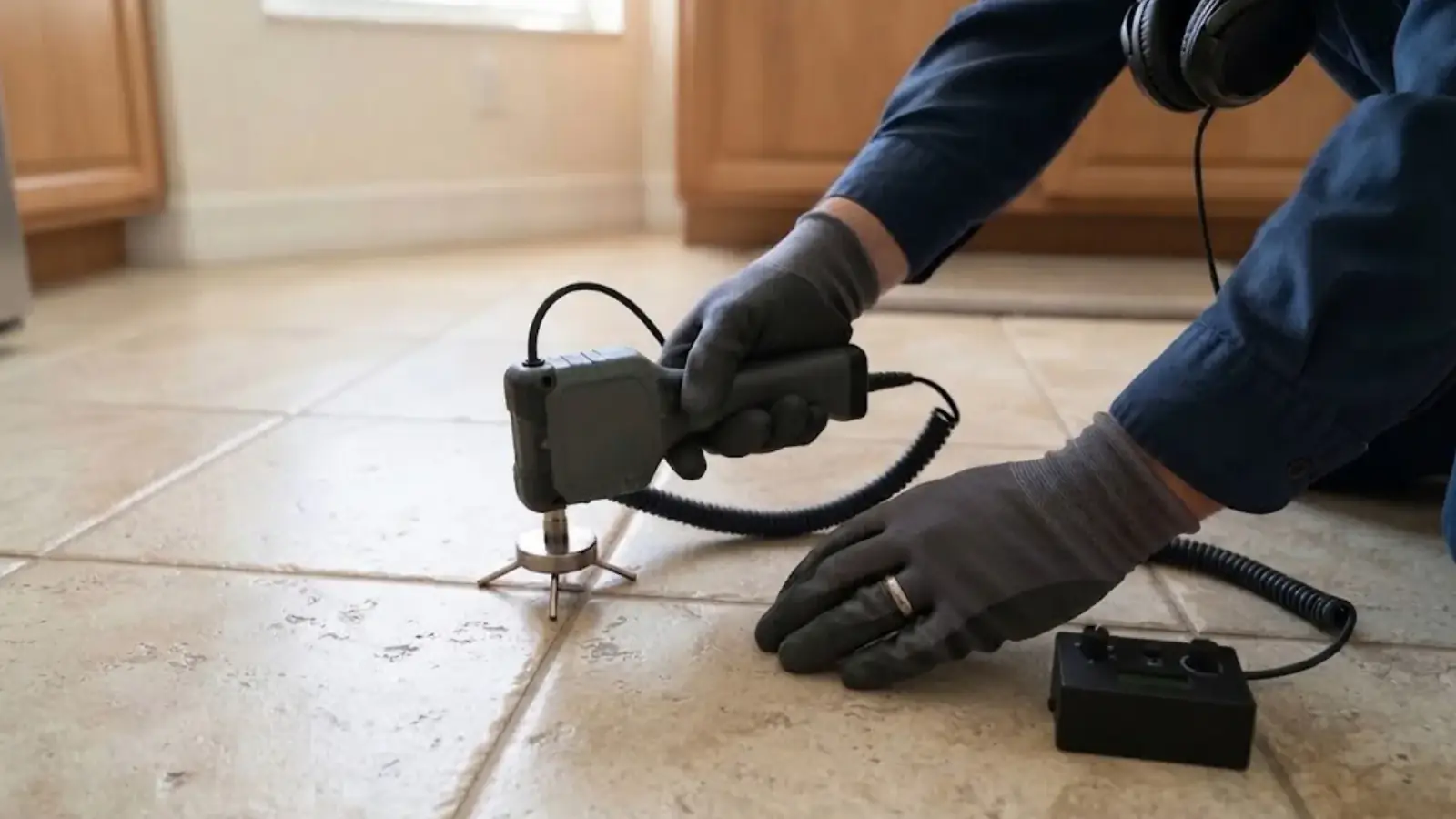
No single tool finds every leak. We pick methods based on what the symptom suggests and combine them when the first result is unclear.
| Method | Best for | Limit |
|---|---|---|
| Pressure test | Confirming a leak exists on a section of line | Tells you if, not where |
| Acoustic listening | Pinpointing a leak on pressurized pipe | Background noise can mask it |
| Thermal imaging | Hot water lines and radiant leaks | Needs a temperature difference |
| Tracer gas | Small leaks that sound silent | Needs the line isolated |
| Camera inspection | Drain lines and cavities | Only shows what the lens reaches |
We use the established tools for each method and make no claim that one outperforms another. What matters is that the result gets checked against a second clue before anyone cuts into drywall, tile or concrete.
Crawlspaces, slabs and buried lines
Atlantic City sits at about 7 feet of elevation on a barrier island, so lines often run through wet ground. A leak under a crawlspace often shows up as damp insulation, a musty smell or sagging subfloor. Underground, a leaking service line can soften soil or drop the pressure at every tap. If we trace the water to the pipe between the street and your building, the next step is covered on our water service line repair page.
Outdoor leaks get their own check. Irrigation zones, a pool or spa fill line and a cracked meter box can each look like a house leak on the bill. We run each system separately so you pay to fix the right one. Call 811 before any digging so buried utilities are marked, and we will never dig without that step.
When a hidden leak becomes an emergency
Call right away if water is coming through a ceiling, if a stain is spreading by the hour, if you hear running water near electrical panels, or if the floor is soft. Shut off the main, turn off power to affected rooms if you can reach the panel safely, move belongings out of the wet area and take photos for your insurer. If you smell gas, leave on foot and call South Jersey Gas at 1-800-582-7060 or 911 first.
We take after-hours leak calls from Atlantic City and nearby towns such as Ventnor City any night of the week, and we schedule same-day appointments when available for leaks that are slow but still costing you. Water heaters are a common source, so ask about checking yours through water heater repair if the tank sits near the stain.
What happens on a detection visit
- 1
Talk through the symptoms
You tell us what you saw, when the bill changed and where the water showed up.
- 2
Isolate the system
We close valves to split the house into zones and see which zone holds pressure.
- 3
Pinpoint the spot
Listening gear, heat imaging or gas narrows the leak to a small area.
- 4
Explain the options
You get the location, the cause and a clear price before work starts.
- 5
Repair or hand off
We fix the pipe, or point you to the roofer or utility if the leak is theirs.
What affects the cost of leak detection
Where the leak is
A line behind an open wall is quicker than one under a slab or driveway.
How many systems to test
Hot, cold, drain, irrigation and pool lines may each need their own pass.
Access
Finished ceilings, tile and tight crawlspaces add time before and after the search.
Method needed
A simple pressure test costs less labor than a combined acoustic and gas trace.
After-hours calls
Time of day can influence the price, so confirm the figure before the visit starts.
Insurers differ on whether the cost of finding a leak is covered. Ask yours, and keep photos, meter readings and the work order.
We give you a clear price before work starts. Call (609) 547-1417.
Questions about leak detection in Atlantic City
Yes. Our emergency line runs 24/7, and active leaks coming through ceilings, walls or floors get priority. Shut off the main valve first and call (609) 547-1417. For slower leaks we offer same-day appointments when available, so you do not have to wait for a bill to arrive.
Turn off every fixture, then watch the leak indicator or sweep hand. Any movement means water is flowing. Close the main valve at the house. If the meter stops, the leak is inside, and if it keeps moving, the leak is on the buried line. Your utility can also confirm usage history.
Often, yes. Depending on the case, pressure tests, acoustic listening or thermal imaging can narrow the location before any cutting starts. When an opening is needed, it is usually a small access cut at the confirmed spot. If you need a section replaced, ask us about repiping options.
No. Guests, a new appliance, seasonal use in a rental or a filling pool can raise a bill. Run the meter test, then compare bills across months. If the meter moves with everything off, treat it as a leak. If it does not, the extra use is coming from something you can see.
We do. Hotels, apartments and shops share the same symptoms, though the piping is usually larger and zoned. Details are on our commercial plumbing page. Tell us the building type when you call so we can plan access.
Not always. Many Atlantic City condos and rowhouses have access panels behind tubs or in utility closets. We check those first. If we do open a wall, we cut as small as we can and tell you the plan before starting.