
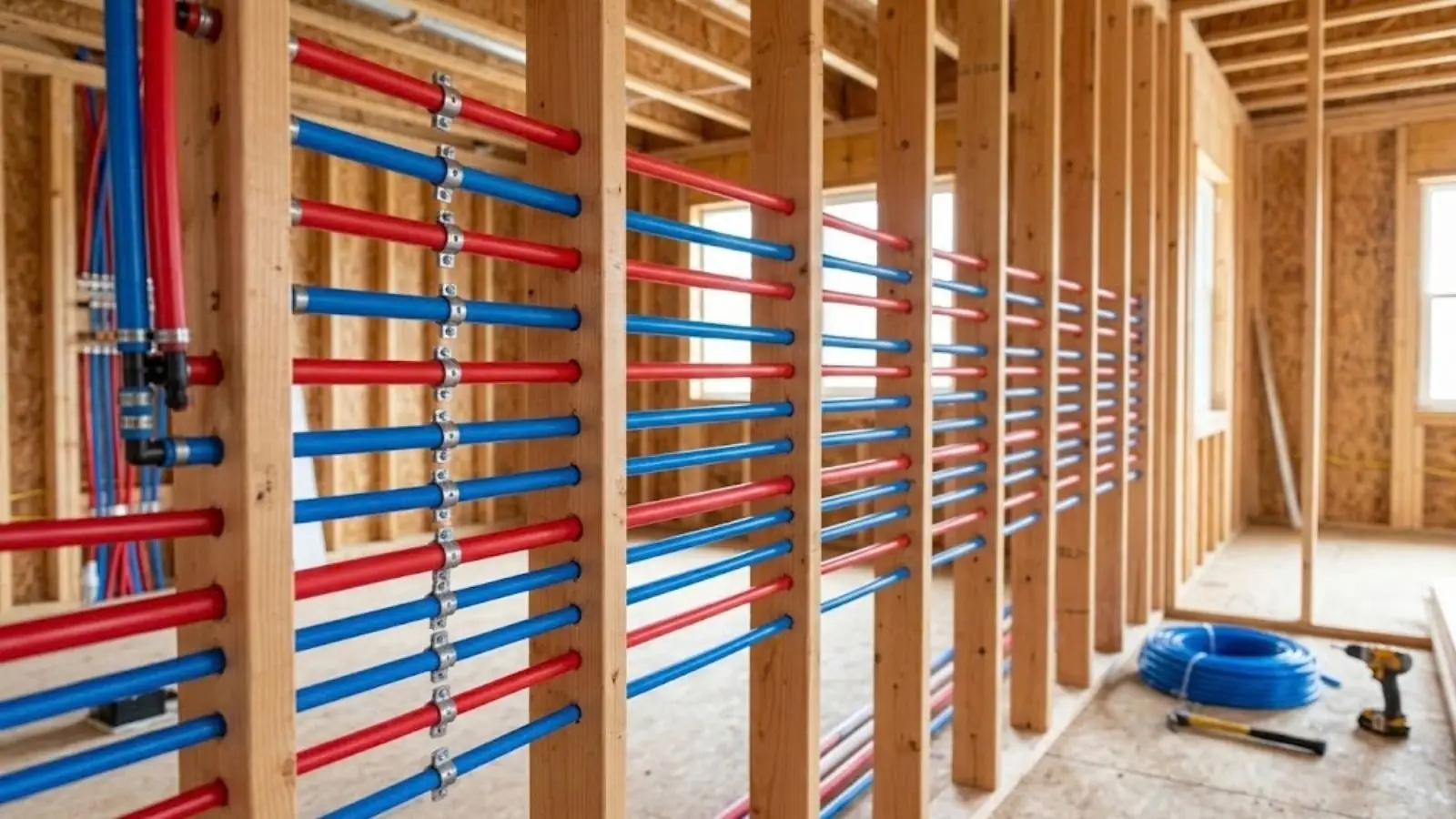
Signs your supply pipes are wearing out
One leak is a repair. A string of leaks in different spots is a pattern, and each patch can push stress onto the next weak section. Other signs show up at the tap. Pressure drops when two fixtures run, hot water is slow, or the water runs brown or orange before it clears.
- Repeated pinhole leaks or wet spots in more than one room.
- Low pressure at fixtures that is not explained by a closed valve.
- Flaking, rust-colored or metallic-tasting water, mostly at first use in the morning.
- Visible corrosion, crusty green or white buildup on joints.
- Galvanized steel pipe, which is gray and magnetic, found in basements, crawlspaces or utility rooms.
If you have an active leak right now, shut the main valve and call about burst pipe repair. Repiping is planned work and is not the same as an emergency repair. If you are not sure where the water is going, leak detection can locate it before you decide.
Pipe materials compared
| Material | Strengths | Watch-outs |
|---|---|---|
| Copper | Long track record, handles heat, rigid and neat | Needs soldered joints, costs more, can pit in some water |
| PEX | Flexible, fewer fittings, quick to run through walls | Must be protected from sunlight, sharp bends and some chemicals |
| CPVC | Rigid plastic, lower cost, no corrosion | Can turn brittle with age and heat |
| Galvanized steel | Was common in older systems | Rusts from inside, narrows over time, the main reason for replacement |
No material is perfect for every building. We recommend one based on what is already in your walls, the water pressure, how many fixtures you have, and the budget. Ask what the fittings are made of, because mixed metals at a joint can corrode. Your water utility, the Atlantic City Municipal Utilities Authority, reports lead and copper results, and its 2023 samples were below action levels at all 30 sites tested.
That report covers the utility's side. Your own pipes are your side, and that is why a repipe starts with a look inside your building, not a guess from the street.
Not sure if it is time to repipe? Call and we will look at the pipes.
Call (609) 547-1417Repiping an occupied home or small building
Most people stay in their homes during a repipe, and a good plan makes that workable. We work in phases, so the water is off for set stretches and not for days at a time. We tell you in advance which sections will be shut, and we restore service at the end of each work period.
Phases of a repipe
- 1
Survey and scope
We trace the main, the risers, the branches and the fixtures, and write down what is included.
- 2
Plan the order
We pick a sequence, often starting with the kitchen and bath lines, so you keep some water.
- 3
Open access
We use existing closets, basements and small wall openings where we can, to keep cutting to a minimum.
- 4
Run new lines
New pipe is run, connected to fixtures and shutoffs, and the old lines are capped or removed.
- 5
Pressure test
The new system is filled and tested for leaks before any wall is closed.
- 6
Close and patch
Access openings are closed and patched to a rough or paint-ready state, with the finish work spelled out in the scope.
Rowhouses, condos and shared walls
In rowhouses, condos and apartment buildings, your pipes may share a wall, a chase or a riser with a neighbor. Ask your property manager or association who owns each section and whether the riser can be shut for a few hours. Your building may have rules about work hours, elevator use and notice to neighbors.
We work only on the lines we are hired to replace. A shared riser is a building decision, and we help you figure out what to ask. The same applies to the water service line that brings water from the street, which is a separate scope.
Spot repairs versus a full repipe
A repipe is a big job, and sometimes a smaller fix is the right call. If leaks are in one section, or the problem is a single failed fitting, replacing that run may be enough. We tell you when that is the case. If the pipe is galvanized and failing from within, patching tends to chase the next leak.
| Situation | Likely path |
|---|---|
| One leak, rest of the pipe in good shape | Spot repair |
| Several leaks in one wing or floor | Replace that section |
| Galvanized pipe with low pressure and discolored water | Full or phased repipe |
| Remodel with walls already open | Repipe while access is easy |
Get the scope in writing before work begins: which lines, which fixtures, which walls get opened, who patches and paints, and whether a permit is expected. Permit rules vary by job, so ask your local construction office. New work is also a good moment to look at plumbing installation upgrades like shutoffs at each fixture.
What affects the cost of repiping
Size of the system
The number of fixtures, floors and feet of pipe sets most of the job.
Pipe material
Copper, PEX and CPVC differ in cost and in labor.
Wall and ceiling access
Finished walls and tight chases take longer than open framing.
Patching and finish
Whether drywall, tile or plaster repair is in the scope or left to others.
Permit needs
If your construction office asks for a permit or inspection, that time is part of the plan.
Replacing worn pipe is typically maintenance and not an insured event. Ask your insurer before you decide, and ask whether a sudden pipe failure would be handled differently.
We walk the building and give a scope and a clear price before work starts. Call (609) 547-1417.
Questions about repiping in Atlantic City
Galvanized pipe is dull gray, threaded at the joints, and a magnet will stick to it. Copper is orange-brown and PEX is plastic in red, blue or white. Look at exposed pipe near the water heater or main shutoff. If you are not sure, send us a photo and we can tell you.
Usually yes. We work in phases so the water is off for planned stretches and back on at the end of the work period. Plan to have bottled water and a backup bathroom if the building has more than one. We discuss the schedule before we begin.
As little as we can. We use closets, basements, crawlspaces and existing openings, then small access holes where we must. We write the plan into the scope, including who patches and who paints. If you want the least cutting, say so at the walk-through.
Rules vary by job and by town, so ask the construction office. New Jersey's Uniform Construction Code governs plumbing work and the local official enforces it. We do not decide for you, and we can tell you what the job includes so you can ask the right question.
If the pipe is in good shape and the leaks are rare, spot repairs make sense. If galvanized pipe is failing and the leaks keep moving, a phased repipe usually costs less than repeated repairs. Ask for both options in writing.
Yes. We serve Atlantic City and nearby towns, including Absecon. Call with the building type, number of units and the pipe you can see, and we tell you what a walk-through would involve.