
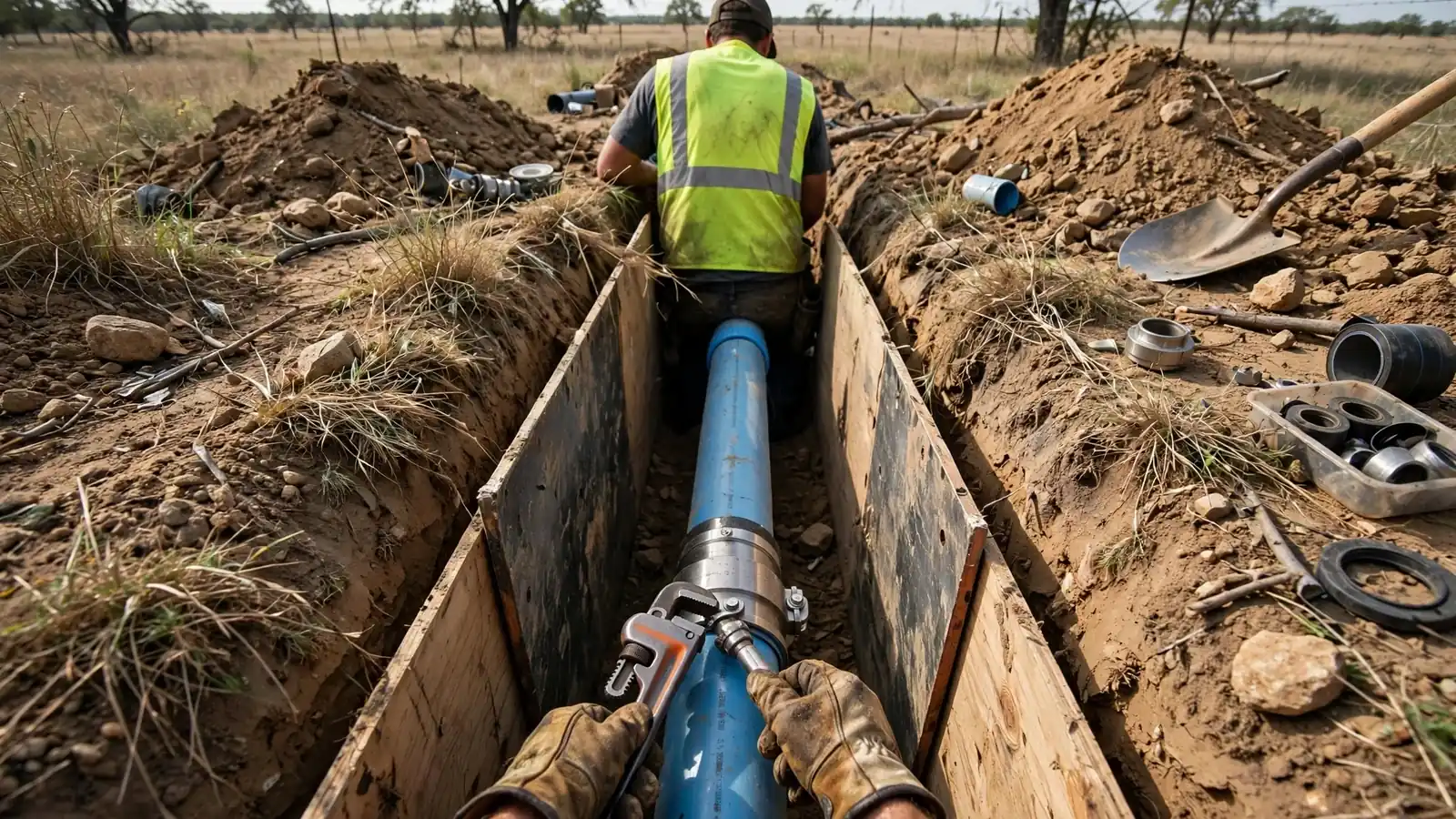
Who is responsible for which part of the line
The service line is the pipe that carries water from the main under the street, through the meter, and into your building. People often assume it is all the utility's problem or all theirs. In practice the split usually falls at the meter, with the utility responsible up to it and the owner responsible after it. Because that point can differ by utility and by property, ask your water utility where its responsibility ends before you pay for any digging.
| Where you are | Utility | Phone |
|---|---|---|
| Atlantic City | ACMUA | (609) 345-3315 |
| Ventnor City | Ventnor City Water Department | 609-823-7935 |
| Pleasantville, Egg Harbor Township, Absecon, Galloway | New Jersey American Water | 1-800-272-1325 |
Call the utility first if water is surfacing near the curb or the meter box, since a break on their side is theirs to fix. If it is on your side, we take over from there. Our crews serve Atlantic City and nearby towns, including Galloway Township.
Signs the line is leaking underground
- A wet, soft or sunken patch of ground between the curb and the house, with no rain to explain it.
- A meter that keeps turning after every fixture in the house is shut off.
- A water bill that climbs with no change in how you use water.
- The sound of running water near the entry point when the house is quiet.
- Muddy or discolored water, or a sudden drop in pressure at every tap.
None of these proves a service line leak on its own. A running toilet or a leaking supply inside the building can look the same on a meter, which is why we separate the two with a quick shutoff test. If the problem is inside, our leak detection work finds it. If the meter keeps spinning with the main closed, the underground line is the suspect.
When a service line failure is an emergency
Water bubbling up in the yard, a sinkhole forming near the foundation, no water at all, or a basement taking on water from outside are emergencies. Close the main valve at the house, stay clear of flooded areas near electrical equipment, and call. We take emergency calls at night and on weekends, and same-day appointments are offered when available for slower leaks.
If the water is clean and flowing from the ground, do not try to patch it yourself. A cracked line under pressure can undermine a driveway or slab within hours. We locate the break, tell you where the utility's part ends, and give a clear price before work starts.
No water, or too much of it in the yard? Call and we will sort out whose pipe it is.
Call (609) 547-1417Low water pressure: check the simple things first
Weak pressure does not always mean a leak. Work through the likely causes before assuming the line is damaged.
- Test pressure at an outdoor spigot and an indoor tap. If both are weak, the issue is upstream of the fixtures.
- Check that the main shutoff valve is fully open. A valve left a quarter turn closed after past work is a common culprit.
- Look for a pressure reducing valve near the entry. A failing one can choke flow or let pressure spike.
- Ask a neighbor or the utility if there is work on the main.
- Consider the pipe itself. Old galvanized service lines scale on the inside and shrink the opening.
If the line is the cause, the choice is between a spot repair and replacement. Where the pipe is narrowed along its whole length, a full replacement is usually the sensible route, and our repiping team can also tie the new line into the interior piping.
Trench or trenchless: how the work is done
| Approach | How it works | Best when |
|---|---|---|
| Open trench | Dig down to the pipe, cut out the bad section, lay new pipe | The break is short, shallow and easy to reach |
| Trenchless | Pull or burst a new line through the old path from small pits | Paving, trees or landscaping are in the way |
Which method fits depends on soil, depth, what sits above the line and what the utility or local construction office requires. Permit rules vary by job, so we tell you to check with your local construction office before any digging. Either way, 811 gets called first so other buried utilities are marked.
Atlantic City is low and flat, and a barrier-island water table can complicate trenching. We look at the site before recommending an approach, and we will say so if conditions point away from a full dig. For related work such as relocating a meter or adding a new line, see plumbing installation.
Before we arrive: what to have ready
Before we arrive
Clear the path
Move vehicles and stored items from the yard or entry point.
Note the meter
Write down the reading and whether it is moving with everything off.
Know your valve
Tell us if you found the main and whether it closes fully.
Photos
Capture wet ground, the meter box and any water stains inside.
Utility contact
Have your account number handy if the utility needs to be involved.
What affects the cost of service line repair
Length and depth
A short, shallow line costs less than a long, deep one.
Pipe material
Copper, plastic and lead-free options differ in cost and labor.
Surface above the line
Lawn, concrete and asphalt each change restoration work.
Method
Open trench and trenchless approaches use different equipment.
Permits and utility coordination
Local rules and shutoff scheduling can affect timing.
Homeowners policies often do not cover underground line wear, though some offer an add-on. Ask your insurer and your utility whether any line protection program applies to you.
We give you a clear price before work starts. Call (609) 547-1417.
Questions about water service line repair in Atlantic City
Yes. The emergency line runs 24/7. Close the main valve, call (609) 547-1417 and tell us what you see at the meter and the yard. If water is flowing from the street side of the meter, also call your utility, since that part may be theirs to repair.
It depends on where the break is. The utility usually covers its side up to the meter and the owner covers the rest, but this varies, so ask your water utility where its responsibility ends. We can tell you which side the failure is on once we locate it.
Sometimes. Trenchless methods use small entry pits instead of a full trench. They suit lines under driveways or mature landscaping. Soil and pipe condition decide whether it works, so we assess the site first and explain the options.
A sudden drop usually points to a partly closed valve, a failed pressure reducing valve or a break in the line. Check the main shutoff first. If the meter spins with everything off, a leak is likely. A slow drop over months suggests pipe scaling.
Yes. We serve Atlantic City and nearby towns, including Pleasantville. Each town has its own water utility, so we tell you who to call about the meter and where the owner's section begins. Confirm local digging rules with the construction office.
No. Call 811 first so gas, electric and water lines are marked. Digging without that step risks damage and injury, and it can leave you responsible for repairs. Let a plumber locate and open the area.