
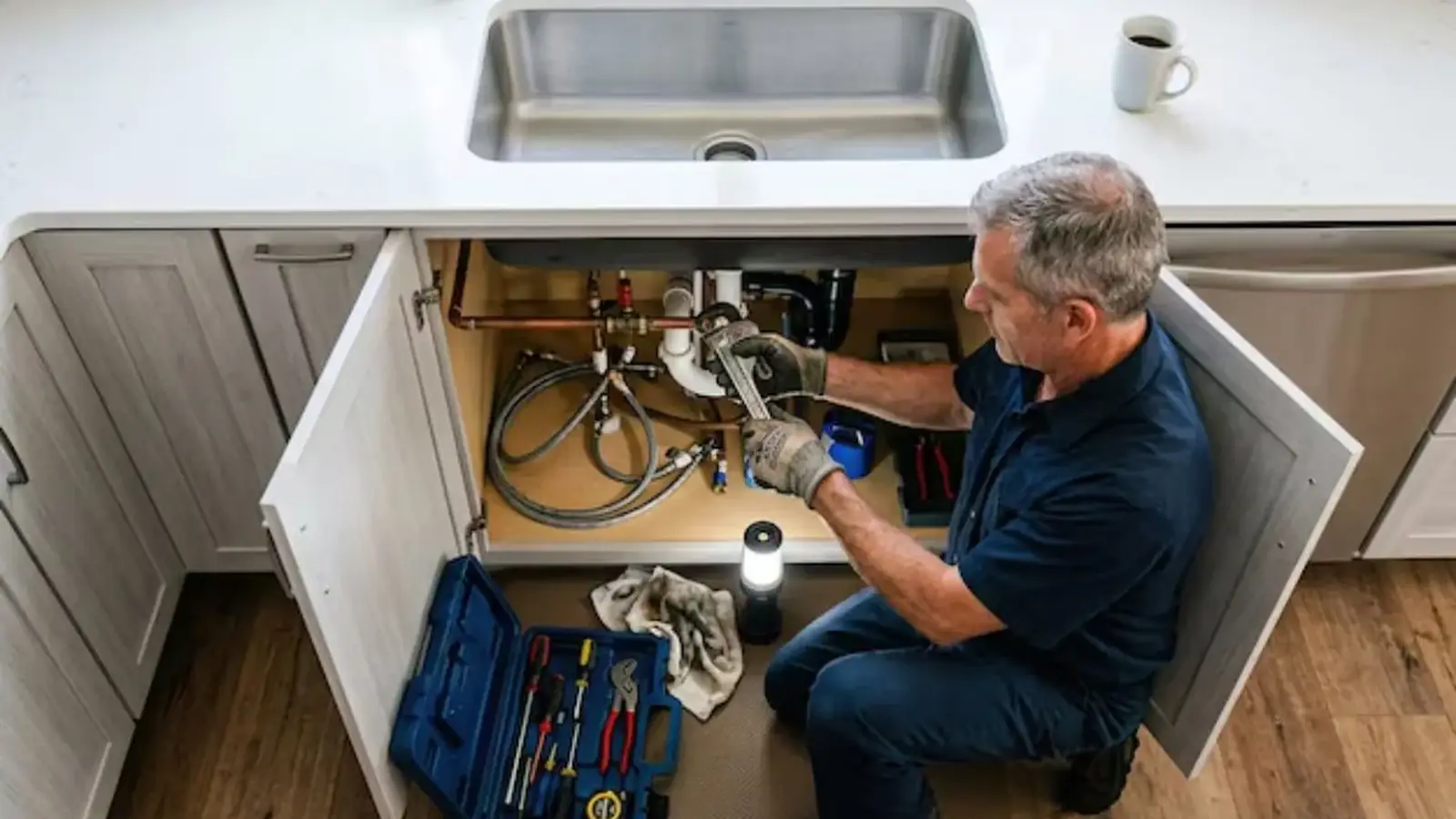
Same spot or new spot: the question that decides who does the work
If the new sink sits where the old one was, the drain and supply pipes already exist, and you are mostly reconnecting them. That is a reasonable weekend project if the shutoff valves work and the pipes are in decent shape. If the sink moves even a couple of feet, the drain slope, the trap arm length and the vent all change, and that is when a plumber should take over.
Our crew does fixture hookups every week through plumbing installation visits, and the most common call is a homeowner who started a swap and found a corroded valve or a drain that does not line up. Knowing what is behind the cabinet before you buy the sink saves a second trip to the store.
Look under the cabinet before you buy anything
Open the cabinet door and take a photo of everything you can see. You are checking five things: the two shutoff valves on the hot and cold lines, the flexible supply lines running up to the faucet, the basket strainer under the bowl, the P-trap, and the pipe that goes into the wall.
- Do the shutoff valves turn fully and stop the water, or are they crusted and stiff?
- Are the supply lines braided steel or plastic, and do they show rust, bulges or white mineral crust at the fittings?
- Is the trap a smooth plastic or chrome U-bend, and does it have any staining that points to a slow leak?
- Does the drain pipe enter the wall at a height that will work with a deeper or shallower new bowl?
- If a dishwasher or disposal connects to the sink, where do their hoses tie into the drain?
Stiff valves are the usual surprise. An old multi-turn valve that has not been moved in a decade may leak at the stem the moment you touch it, so plan to replace both while the water is off.
Shut the water off the safe way
- Close both small valves under the sink by turning them clockwise until they stop. Do not force them past firm resistance.
- Open the faucet and let it run until the flow stops, which also bleeds pressure from the lines.
- If a valve will not close or keeps dripping, stop and close the main shutoff for the home or building instead.
- Put a bucket and a towel under the trap before loosening anything. A trap holds a cup or more of dirty water.
- If you cannot find the main shutoff in a condo or apartment, ask building management before you start.
Never keep working on a valve that sprays or will not seat. Close the main and call for help, because a failed valve stem can turn a ten-minute swap into a flooded kitchen.
The drain side explained
The basket strainer sits in the sink hole and is sealed with plumber's putty or a gasket. Below it, a tailpiece drops into the P-trap, which holds a small plug of water that blocks sewer gas from entering the room. From the trap, a horizontal trap arm runs to the wall, where the drain joins the building line.
Slope matters here. The trap arm should fall gently toward the wall, and it should not run much farther than your local code allows from the vent. This is why moving a sink is not just a longer pipe. Water that drains too fast or too slowly causes gurgling, slow drainage and trap seal loss.
| Task | Homeowner-friendly? | Why |
|---|---|---|
| Replace faucet and supply lines | Usually yes | Shutoffs are close at hand and parts are standard |
| Swap sink bowl in same cutout | Usually yes | Mostly sealing and clamping, no new piping |
| Replace shutoff valves | With care | A seized valve may need the main off |
| Change trap and tailpiece | Yes, if lined up | Pipe sizes and alignment must match |
| Move the sink or drain | No | Slope, trap arm and vent all change |
| Add a vent or reroute inside a wall | No | Open walls and code rules are involved |
| Connect a gas appliance nearby | No | Gas work needs a licensed professional |
Local note
Local note: your tap water source
Atlantic City water comes from the Atlantic City Municipal Utilities Authority, which reports drawing from two reservoirs and 13 wells. Its 2023 lead and copper tap samples showed 0 of 30 sites above action levels, and the report does not list hardness.
What that means for your sink job: the utility result tells you nothing about your own pipes, so if you replace old supply lines or valves in an older building, test your tap for lead and ask ACMUA about sampling. Do not assume hardness either way.
Stuck under the cabinet with a seized valve? Call us and we will talk through what you are seeing.
Call (609) 547-1417Vents and why they get overlooked
A vent is a pipe that lets air into the drain system so water can flow without pulling the trap dry. Most kitchen sinks vent through the wall behind the cabinet and up through the roof or through an air admittance valve where the local code allows it. You usually cannot see it from under the sink.
If you only swap the sink and faucet, the vent is untouched and you can ignore it. If you change the drain location, the vent has to be checked, and that is a job for a plumber who can open the wall and read the layout. Ask your local construction office what permits and inspections apply, since rules vary by job.
Supply lines, valves and the faucet connection
Braided stainless supply lines are the common choice, and they tighten by hand plus a quarter turn with a wrench. Over-tightening cracks the plastic nut or cuts the washer. Always use new lines with a new faucet instead of reusing the old ones, because rubber gaskets flatten with age.
After you turn the valves back on, check each joint with a dry paper towel. Wipe, wait, and look again after fifteen minutes, then once more after a full day. Slow weeps are easy to miss and do the most cabinet damage.
A sensible order of work for a same-spot swap
- 1
Clear and photograph
Empty the cabinet, take pictures of the pipes and note which side the hot line is on.
- 2
Water off, lines drained
Close both valves, open the faucet, and set a bucket under the trap.
- 3
Disconnect and remove
Undo the supply lines, loosen the trap nuts, then free the old sink from its clips or sealant.
- 4
Set the new sink
Clean the counter edge, fit the sink with its gasket or sealant, and secure the clamps.
- 5
Reconnect drain first
Install the basket strainer, tailpiece and trap, checking that the trap arm slopes toward the wall.
- 6
Connect supply and test
Attach new lines, open the valves slowly, run both taps and check every joint dry.
When a licensed plumber is the right call
Call a plumber when the valves will not close, when the drain has to move, when the pipes behind the cabinet are galvanized and corroded, or when a disposal, dishwasher or filtration line complicates the layout. A pipe that looks fine can crumble the moment you unscrew it. Our garbage disposal repair visits often start with a sink swap that went sideways.
In New Jersey, plumbing work is governed by the Uniform Construction Code, which your local construction official enforces. You can verify any plumber's license through the Division of Consumer Affairs license verification for the State Board of Examiners of Master Plumbers. We are licensed and insured, we give a clear price before work starts, and we offer same-day appointments when available.
Customers in nearby towns call us too, including homeowners in Ventnor City and Pleasantville. Call (609) 547-1417 and tell us what you see under the cabinet.
Quick answers
Often yes, when the new sink goes in the same spot and the pipes are sound. Moving drains, vents or gas lines is licensed plumbing work. Rules on permits vary by job, so ask your local construction office before you start.
A straight swap with good valves takes a few hours. Seized valves, rusted drain parts or a cabinet that needs trimming add time. We tell you what we see and give a clear price before work starts.
Replacing them is wise if they are old, stiff or drip at the stem. A valve that fails during the swap forces you to shut off the whole building. New quarter-turn valves cost little compared with a flooded cabinet.
Usual causes are a trap arm that slopes the wrong way, a crushed or misaligned tailpiece, or a missing vent path. Debris dropped during installation can also block the trap. A plumber can check slope and venting quickly.
We advise against it. Rubber washers harden and the braided jacket can rust inside. New lines are cheap and a leak at the cabinet floor is slow and expensive to find.
They can be. Many Atlantic City homes are condominiums, apartments and rowhouses, so the shutoff you need may be shared, or the building may have rules about who works on its pipes. Ask building management first, and call us if the valves are hard to reach or fail to close. Our installation service covers planned fixture work.