
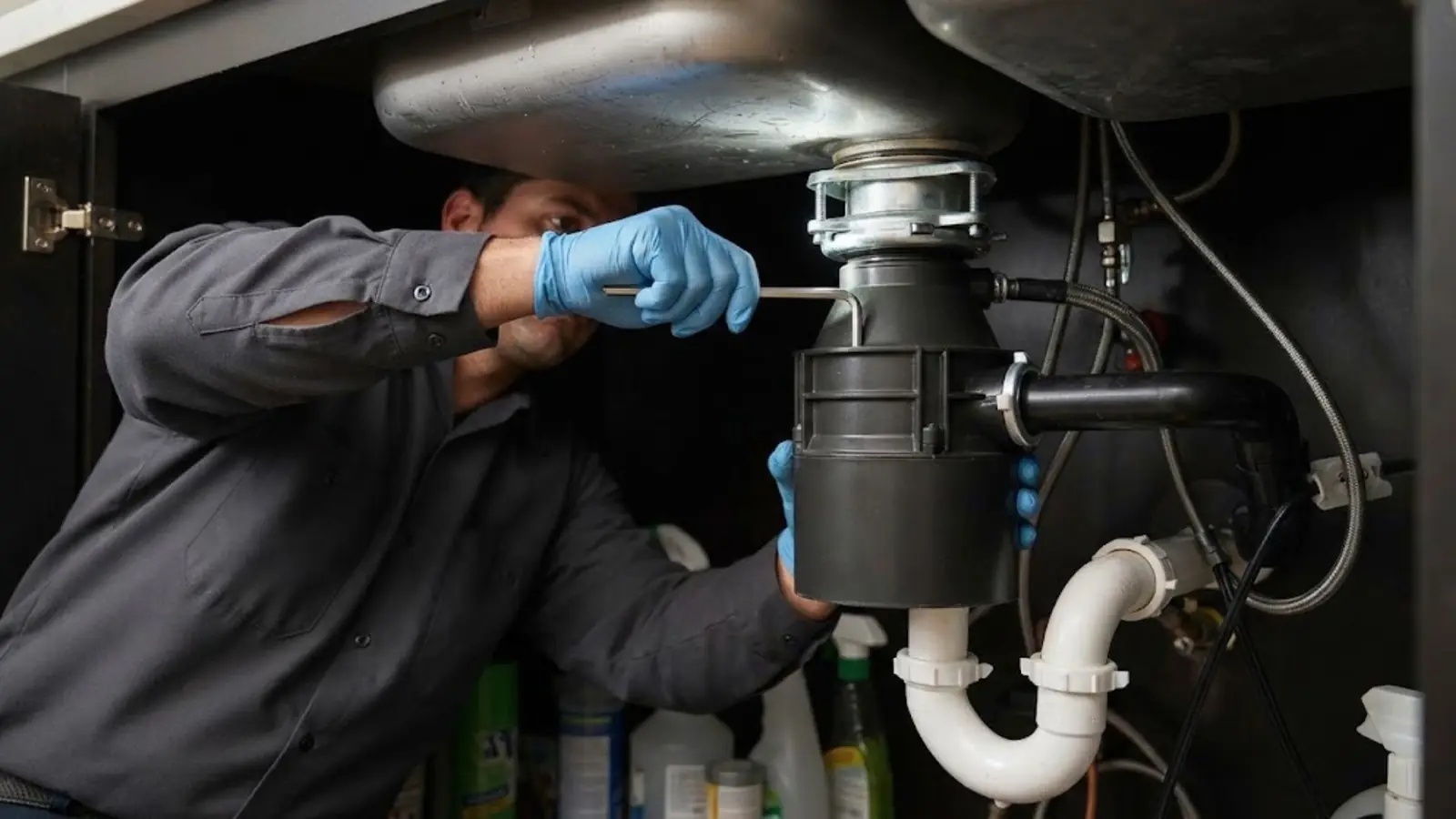
Disposal leaking under the sink: what to do first
Water under the cabinet is the call we hear most. Turn the wall switch off, then unplug the unit or flip its breaker, and set a bowl or baking tray under the leak. Do not run the dishwasher or the faucet again until someone has looked at it.
- Empty the cabinet floor of cleaners and boxes so the wood stays dry.
- Wipe the underside of the unit and the pipes with a dry towel, then watch where the first drop forms.
- Take a phone photo of the drip point and of the label on the side of the unit.
- If water is reaching an outlet or the cord, shut off the kitchen breaker before you touch anything.
The photo and the label help us bring the right seal kit or a matching replacement. If the sink basin itself is overflowing rather than the unit leaking, the problem is likely a clogged line, which our drain cleaning service handles.
Reading the symptom before anyone opens the unit
| What you notice | Likely cause | Safe check for you |
|---|---|---|
| Humming, nothing spins | Jammed grinding plate | Power off, then use the hex key socket underneath |
| Dead silent, no hum | Tripped reset or no power | Press the red reset button on the bottom |
| Drip at the top rim | Failed flange seal or putty | Photograph it and leave it off |
| Drip from the side or bottom | Cracked housing or worn seal | Stop using it, replacement likely |
| Water pools after a run | Loose drain connection or slow line | Check the cabinet for wet pipe joints |
| Foul smell, slow drain | Debris stuck in the chamber | Flush with cold water, no chemicals |
Jam or hum: the reset button and the hex key
A hum with no spinning means the motor is trying to turn a stuck plate. Cut power first, at the switch and at the plug or breaker. Then look under the unit for a small hex socket in the center and a red reset button near the bottom edge.
Working the hex key back and forth frees most light jams. Press reset after the plate moves freely, then restore power and run cold water. Never put a hand, a spoon or tongs into the chamber to dig, even with the power off, because the plate can move and the blades are sharp. If the unit trips again or the hum returns, stop and call.
Stuck disposal and a sink full of dishes? Call the line any hour and we will talk you through it.
Call (609) 547-1417Where the leak starts: flange, body or drain connection
Three leak points and what each one costs you in repair scope
Flange at the sink drain
Water at the top rim means the seal or plumber's putty under the sink flange has failed. This is often a reseat and not a new unit.
Housing body
A leak from the side or bottom of the shell usually means internal seals or the casing have given out. Replacement is the sensible path here.
Drain and trap connections
Loose slip nuts, a cracked discharge elbow or a worn gasket leak when the unit runs. These repairs are small and the disposal keeps its life.
Dishwasher hose
A clamp that has loosened on the dishwasher inlet drips only during a dishwasher cycle. We re-seat the line and test it under load.
Repair or replace: how we decide
We open the cabinet, find the exact leak or fault, and tell you the price before work starts. A jam, a tripped reset or a loose connection is a repair. A cracked body, a seized motor or a unit that has leaked from the shell is a replacement.
Most households choose between a modest unit and a heavier one with more motor power. Heavier units cost more and grind more, but they only help if your drain line can carry the extra flow away. If the line is the weak point, a replacement will not solve the slow drain.
What a disposal visit looks like
- 1
Power off and look
We confirm the unit is dead at the breaker, then look at the cabinet, the flange and every joint.
- 2
Free the jam or find the leak
We clear the plate with the proper tool or trace the water to its source with a dry wipe and a light.
- 3
Quote the fix
You hear the repair or replacement price before we pick up a wrench to start.
- 4
Repair, reseat or replace
We rebuild the connection or swap the unit, and reconnect the dishwasher line and power.
- 5
Run it under load
We run water and the dishwasher together and check every joint stays dry before we leave.
Power, sizing and the dishwasher connection
A disposal either plugs into an outlet under the sink or is hardwired to a switch. We match what is already there. If the outlet or wiring looks wrong, we tell you and recommend a licensed electrician for that part, because we only do plumbing.
The dishwasher drain ties into the disposal inlet through a knockout plug that must be removed on a new unit, or the dishwasher will not drain. We also check the high loop or air gap on the dishwasher line, which keeps dirty water from flowing back. New fixtures nearby may call for plumbing installation work, and a dripping faucet above the sink is a separate faucet repair.
What should never go down the disposal
- Grease, oil and fat, which coat the drain line and harden into a plug further down.
- Coffee grounds and eggshells in quantity, since they pack into sludge in the trap.
- Fibrous scraps such as celery, corn husks and onion skins.
- Rice, pasta and potato peels, which swell and turn to paste.
- Bones, fruit pits and anything hard, plus glass, metal or plastic.
If the drain behind the disposal is already slow, grinding more food only makes it worse. Repeat clogs in a kitchen line sometimes need hydro-jetting to scour the pipe clean, which we explain at the visit.
Busy kitchens, rentals and late-night calls
A disposal that fails in a rental unit or a working kitchen cannot wait for a business-hours slot. Same-day appointments are offered when available, and after-hours calls go to the same dispatch line. We also serve Egg Harbor Township and other nearby towns.
What affects the cost of garbage disposal repair
Repair or replacement
A freed jam or reseated flange costs far less than a new unit with installation.
Unit size and type
Heavier motors and sound-insulated models cost more than basic ones.
Wiring and plug type
A hardwired unit or a missing outlet adds work that a plug-in swap avoids.
Condition of the drain below
Corroded slip nuts, a cracked elbow or a clogged line can add parts or a drain service.
After-hours work
Timing can affect the price, so ask for the figure first.
A worn seal is wear, which policies generally exclude, while a sudden flood from a failed line may be treated differently. Keep photos and ask your insurer before you rely on a claim.
Ask for the price before we start. Call (609) 547-1417.
Questions about garbage disposal repair in Atlantic City
Yes. The dispatch line runs 24/7, so a flooding cabinet at midnight gets the same attention as a Tuesday morning call. Same-day appointments are offered when available. Turn the unit off, protect the cabinet floor, and call (609) 547-1417 so we can plan the visit.
Usually not. A hum means the motor has power but the grinding plate is stuck. Turn the power off first, then turn the hex key socket under the unit back and forth until it moves freely, and press the red reset button. Never put your hand inside the chamber.
It can be minor, but it can ruin a cabinet floor over time. A top-rim drip often means a failed flange seal, which is a repair and not a new unit. Stop using the sink until it is checked, and photograph the spot for us.
Yes, within what your sink opening and wiring allow. We match the mounting, the dishwasher inlet and the power setup, and we tell you if a larger unit would not help because your drain line is the limit. Pricing is clear before the work starts.
We will not claim a number, since it depends on the unit and how it is used. What we do see is corrosion on metal fittings under sinks near the shore, so wipe the cabinet dry and report any green crust early. Our leak detection service can trace hidden moisture.
Yes. We remove the knockout plug if needed, reconnect the drain hose, and check the high loop or air gap. Then we run the dishwasher with the disposal and watch every joint to confirm nothing weeps.