
If your drains are backing up right now, stop using water in the building and keep the lowest floor drain clear of belongings. Jetting is a strong tool, so we look inside the line with a camera before we use it. Call (609) 547-1417 and we will tell you whether jetting is the right first step or whether something else comes first.
How a hydro jet works
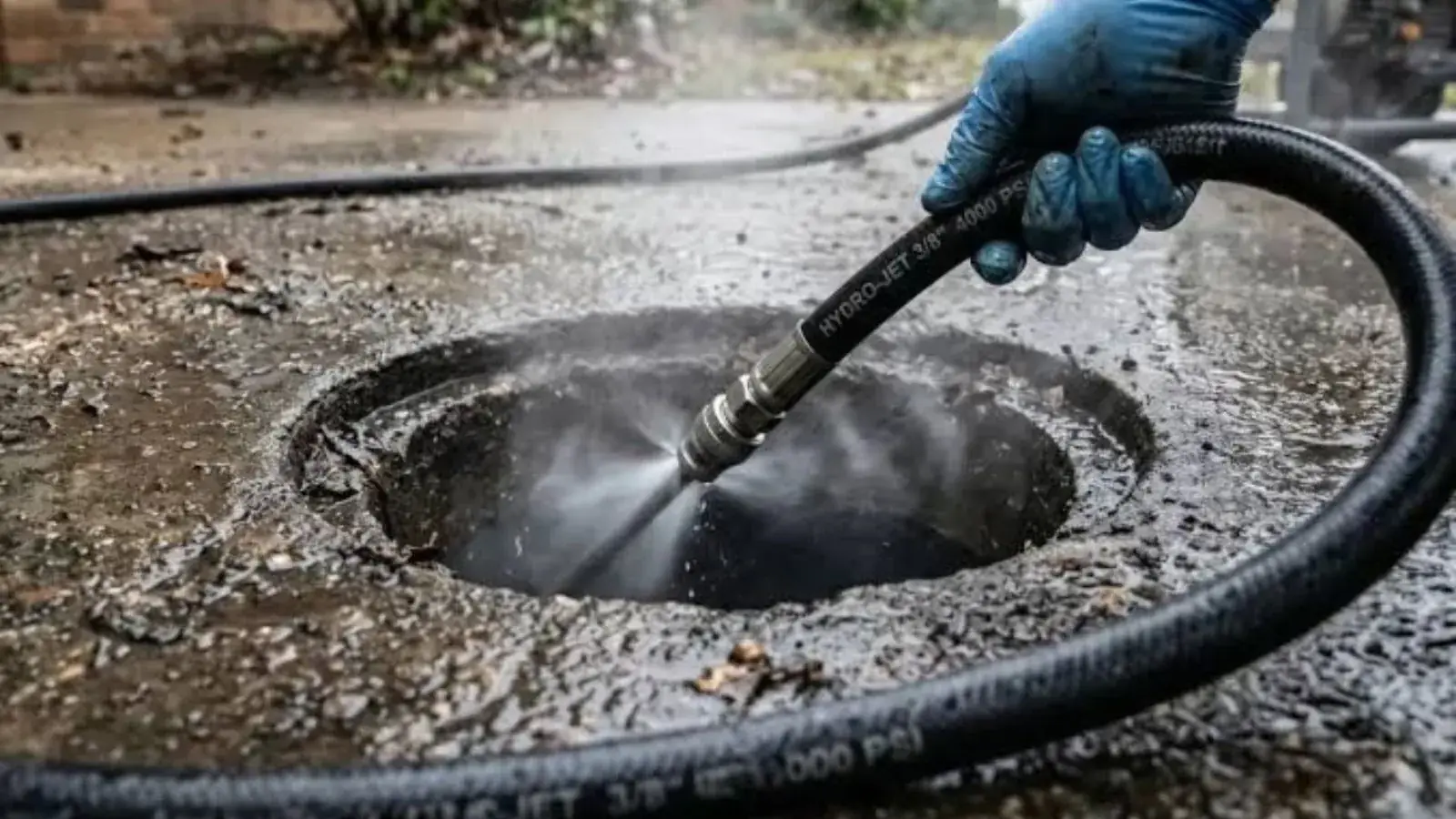
A jetter pumps water through a hose that ends in a nozzle with several small openings. Some jets point backward and pull the hose forward through the pipe. Others point outward and spin or sweep the pipe wall. The result is a scrubbing action across the full inside surface, not just a hole through the middle of the clog.
Pressure and flow both matter. Jetters run at pressures in the thousands of psi at the pump, but that figure varies by machine and job, and a careful operator dials it back for old or thin pipe. The nozzle shape matters as much as the pressure: a penetrating nozzle opens a blockage, while a wide-fan nozzle cleans the walls.
| Question | Cable (snake) | Hydro jet |
|---|---|---|
| What it does | Cuts or pulls through the blockage | Scours the whole pipe wall with water |
| Best for | Hair, a soft stoppage, one fixture | Grease buildup, scale, silt, roots |
| Leaves behind | A thin coat of residue on the wall | A cleaner wall in the cleaned section |
| Risk on weak pipe | Low to moderate | Higher, so camera first |
| Water used | Little | Substantial, so drainage must be clear |
| Typical repeat time | Weeks to months if grease remains | Longer between clogs when the cause was buildup |
Snaked, and it clogged again
This is the call we hear most often. A cable passes through, water drains, and within weeks the same drain slows again. That pattern usually means the pipe wall is coated or narrowed, so the cable only cleared a channel through a still-restricted line. For ordinary single-fixture clogs, our drain cleaning page covers the cable work. Jetting is what follows when the pattern repeats.
- The cable got stuck or came back wrapped in roots, which suggests roots entering at a joint.
- A kitchen or restaurant line fills with grease every month or two.
- Water drains slowly in several fixtures even after cabling.
- A camera shows scale or hard deposits narrowing the pipe.
- The line is long, with several bends, and a cable cannot clean the far end.
Cabled it and the clog came back? Call and describe the pattern so we can pick the right method.
Call (609) 547-1417When a sewer backup cannot wait
When sewage or gray water is rising, the goal is to restore flow first and decide on a longer-term fix after. For a full building backup, the first move is often a main line cable, and jetting follows when the line is still restricted. Our sewer line cleaning page explains the backup case in detail.
We take after-hours jetting calls on the emergency line, and same-day appointments are available when the schedule allows. A late-night call still begins with a camera or access check, because blasting water into a cracked pipe can send debris and water into the soil around it.
Worth knowing
When jetting is the wrong tool
Jetting cleans a pipe that is intact. It does not repair one. A collapsed section, a large offset or a cracked clay pipe can fail or leak further under high pressure, and water may escape into the soil.
That is why a camera comes first when the line is old or the history is unknown. If the picture shows damage, we explain the repair route on our sewer line repair page rather than jetting through a break.
Older pipe and what we adjust
As general trade knowledge, older cast iron develops a rough, scaled interior, and old clay or fiber lines can have loose joints. We do not claim to know what pipe lies under any given Atlantic City street. We look first, then set the nozzle and pressure to suit what the camera shows. On thin or corroded pipe, a lower setting and a slower pass are the safer path.
If the pipe is sound but rough, some owners later ask about a liner, an epoxy coating applied inside the cleaned pipe. A line must be thoroughly cleaned before lining, so jetting is often the first stage. Whether lining suits your pipe is a separate decision, explained under repair options.
Getting ready, running the job, cleaning up
- 1
Clear the work area
Move belongings away from the cleanout or floor drain, and tell us where water and electrical panels are.
- 2
Camera look
We pass a camera through the line to see its condition and identify the blockage.
- 3
Set up the jetter
The hose goes in through the cleanout. We select a nozzle and pressure to suit the pipe and blockage.
- 4
Work the line
We pull the hose back slowly, scouring the wall, and flush loosened debris toward the main.
- 5
Final check and cleanup
We run water, confirm full flow, hose down the work area and show you what came out.
What affects the cost of hydro jetting
Line length and size
A longer or larger-diameter line takes more time and water than a short residential branch.
Access point
A proper cleanout is straightforward. Without one, we may need to pull a fixture or create access.
Camera work
Looking before and after adds time but protects both the pipe and your decision-making.
Severity of buildup
Heavy grease or root mass requires multiple passes.
After-hours work
Ask whether a night or weekend visit changes the figure, and get the answer before work starts.
Jetting is a maintenance service, and policies generally treat maintenance as the owner's cost. If a backup already damaged floors, ask your insurer about that damage separately.
You get a clear price before work starts. For questions about your line, call (609) 547-1417.
Restaurants, rentals and busy buildings
Grease-heavy kitchens, multi-unit buildings and rentals clog the same lines repeatedly, which is where scheduled jetting pays off. Owners with food service or larger properties can read about commercial plumbing work, and a recurring jetting visit often costs less than repeated emergency calls.
Not sure whether jetting suits your pipe? A sewer camera inspection answers that first and gives you video of the line to keep on file.
Questions about hydro jetting in Atlantic City
Yes. The line at (609) 547-1417 is open 24/7, and we book same-day appointments when available. If a line is actively backing up, tell dispatch which fixtures are affected. We still look inside the pipe before jetting unless the situation makes that impossible.
On intact pipe, a properly set jetter is safe. On cracked, collapsed or badly corroded pipe, high pressure can worsen damage. That is why we run a camera first on older or unknown lines and adjust the pressure for what we see.
It depends on the cause. Hair and soft stoppages clear fine with a cable. Grease, scale and roots coat the wall, and jetting cleans the wall rather than just opening a hole. See our drain cleaning page for the cable side.
No. Jetting clears roots from inside the pipe, but if they enter through a crack or loose joint, they can grow back. Repairing or lining the entry point is the lasting fix, and we explain that plainly when the camera shows it.
A jetter uses a good deal of water, and it must drain away. If the line is fully blocked, we open it first so flow has somewhere to go. In a basement or low floor, we protect the area around the cleanout before starting.
We do not assume what is under any street. Older homes and rowhouses may have cast iron or clay, so we look first and set pressure to match. If you rent, share the camera findings with your landlord.