
Stop all water use now. Do not flush, run the shower, or start the washing machine, because each drop adds to the backup. Then read the first-steps list below and call (609) 547-1417 for sewer line cleaning.
Sewer backup: what to do first
- Stop using every drain and toilet in the building, and ask neighbors in a shared building to do the same.
- Keep people and pets away from any overflowing floor drain, tub or toilet, and wear gloves and boots if you must step in it.
- Move belongings, rugs and electronics off the floor, and turn off power to a flooded basement only if you can reach the panel without standing in water.
- Open windows for ventilation if the smell is strong, and call 911 if anyone feels dizzy or sick.
- Photograph the water line and affected items, then call us with the details.
Same-day appointments are available when the schedule allows, and the emergency line is staffed after hours. Calls at night get the same dispatch process as daytime calls, so describe which drains are backing up and how high the water is.
How to tell a main line blockage from a single clog
| What you see | What it means | Page to read |
|---|---|---|
| Lowest drain overflows when upstairs fixtures run | Main line blocked downstream of every branch | This page |
| Toilet bubbles when the tub drains | Branch tied to the main, possibly the main itself | This page |
| One sink slow, others fine | Local clog at the fixture | Drain cleaning |
| Wet yard, sinkhole or repeated backups after cleaning | Broken or collapsed pipe | Sewer line repair |
| Backup only during heavy rain or very high tide | Water entering the system from outside | Ask the utility, then see below |
If the symptoms are limited to one fixture, our drain cleaning service is the fit. When the whole building is involved, a main line cable or jetter is needed, and that is the work on this page.
Every drain slow or one overflowing at the bottom? Call now and describe what you see.
Call (609) 547-1417Finding the cleanout
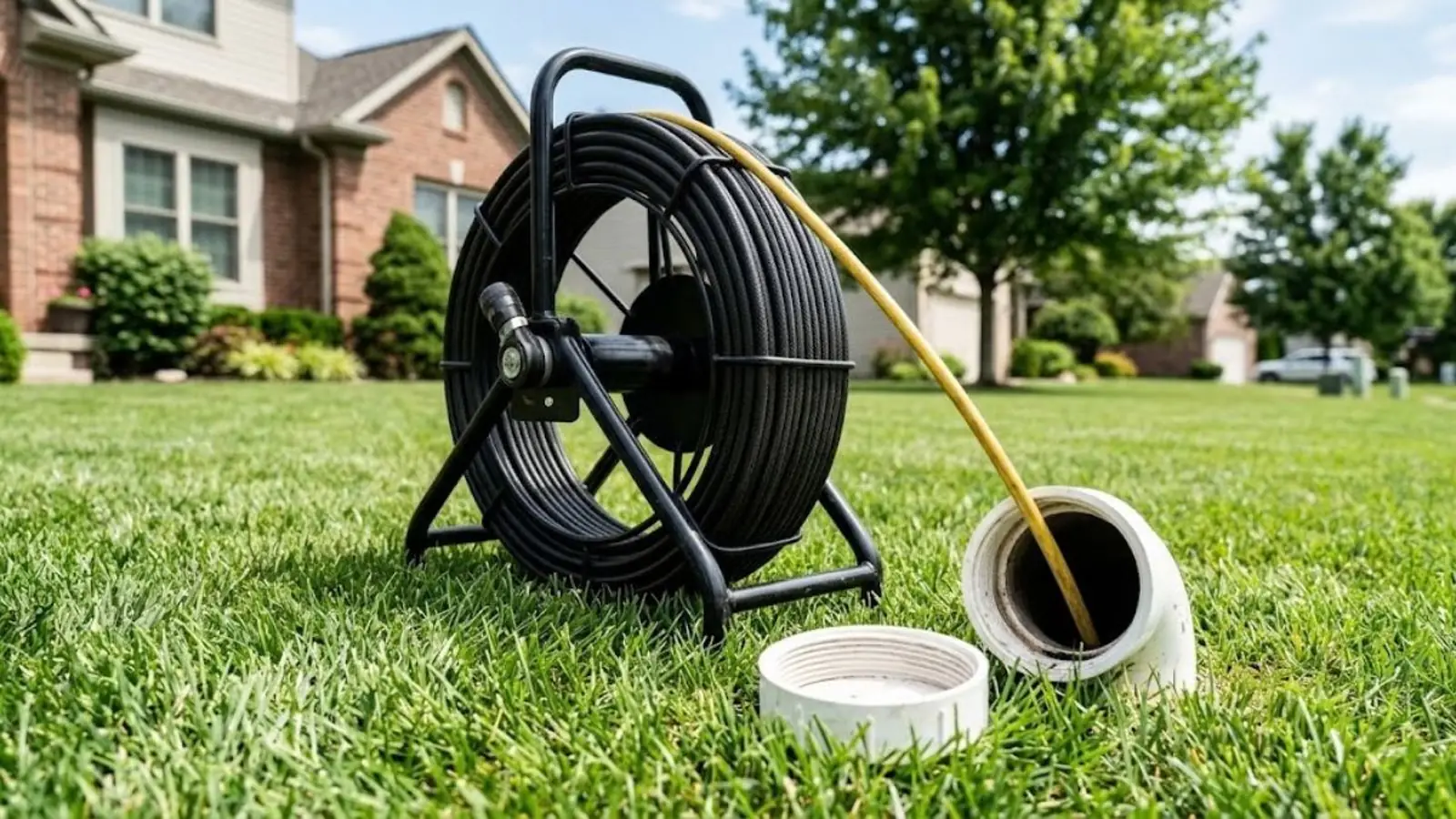
A cleanout is a capped pipe, usually white plastic or black iron, that gives direct access to the main line. Look in the basement near the foundation wall, in a utility room, in a crawl space or outside along the foundation. Do not open it yourself if the line is full, since the standing sewage can pour out.
If you cannot find one, say so on the call. Without a cleanout, we may need to pull a toilet or work through a roof vent, which affects time and cost. A missing cleanout is also worth fixing later so future cleaning is simpler.
What we do on the main line
We run a heavy-duty cable with a cutting head through the cleanout to open the blockage, then flush the line with water to confirm flow. Where roots or grease have coated the walls, we use hydro jetting to clean the pipe rather than just opening a hole in it. If anything about the line looks wrong, we offer a camera look.
Cleaning is not repair. If the camera shows a broken or offset section, clearing it only buys time, and we tell you so. Our sewer line repair page explains what the next step involves.
Storms, high tides and backups
Atlantic City sits at about 7 feet in elevation on a barrier island, so tidal flooding is part of life here. The National Weather Service uses its Atlantic City tide gauge to define flood stages, at 6.0 feet for minor, 7.0 for moderate and 8.0 for major flooding. Sandy peaked at 8.8 feet on October 29, 2012. Reporting on the city also notes that water can rise through storm sewers during full-moon high tides and storms.
Here is what that means for you. If your backup happens during a storm or a very high tide, tell the dispatcher, because cleaning the line may not stop water entering from outside the pipe. We cannot tell you which streets flood, and we do not claim to. Ask the city or ACMUA about conditions on your street.
The Atlantic County Utilities Authority lists a wastewater treatment plant at 1801 Absecon Blvd in Atlantic City. Which agency owns the sewer main under your street is something to confirm with the city or ACMUA, and it matters if the blockage turns out to be beyond your property line.
Local note
After the water goes down
Treat any area touched by sewage as contaminated. Remove soaked porous items such as carpet padding and cardboard, wash hard surfaces with a household disinfectant and run fans to dry the space.
Photograph everything before you clean and keep damaged items until your insurer has seen them.
The cleaning visit, start to finish
- 1
Locate and protect
We find the cleanout, lay protection around it and check which fixtures are affected.
- 2
Open the line
The cable goes in and works through the blockage until water moves freely.
- 3
Flush and test
We run water through the line and watch each low drain for rising levels.
- 4
Clean the line walls if needed
Where buildup caused the stoppage, we jet or make additional passes.
- 5
Explain and advise
We tell you what we found, what likely caused it and whether a camera look or repair makes sense.
What affects the cost of sewer line cleaning
Cleanout access
A good cleanout speeds the job. Pulling a toilet or using a roof vent adds time.
Line length and depth
A longer run from the building to the main requires more cable and effort.
Cause of the stoppage
A soft grease plug is simpler than a mass of roots or a foreign object.
Method
Cable work and jetting use different equipment and time.
After-hours work
Ask whether a night or weekend visit changes the figure, and get the answer before work starts.
Homeowners policies usually cover sudden and accidental water damage but not wear or maintenance, and many policies treat sewer backup as an optional add-on. Ask your insurer before you need it.
We give a clear price before work starts. For a backup, call (609) 547-1417.
Why backups come back
A line that clogs twice in a season usually has an underlying cause, such as roots, grease, a sag where waste settles or a broken joint. A camera inspection shows which one. Pleasantville and other nearby towns have similar questions, and our Pleasantville plumbers help neighbors with the same.
Questions about sewer line cleaning in Atlantic City
Yes. The emergency line at (609) 547-1417 is open 24/7, and we book same-day appointments when available. Tell dispatch which drains are overflowing and whether the water is rising so the right cable and jetting gear goes on the truck.
No. Chemical cleaner will not dissolve a main line blockage and can burn skin when the line is opened. It also makes the work more hazardous for the plumber. Stop water use and call instead.
Possibly not. If water enters from outside the pipe during heavy rain or very high tides, a clean line does not stop it. Tell us when it happens, and ask the city or ACMUA about your street, since we cannot say which streets flood.
Which agency owns the main on your street must be confirmed with the city or ACMUA. A cleanout on your property and a camera look help show where the blockage sits. We tell you what we find, and you can pass it to the owner of the main.
Yes, treat the area as contaminated. Remove soaked porous items, disinfect hard surfaces and dry the space quickly. Photograph everything first for your insurer. If you are unsure, our drain cleaning team can advise when we are there.
It can, if the cause remains. Roots, grease, a sag or a broken joint all cause repeat stoppages. A camera look after clearing shows the cause, and we explain whether jetting or repair is the better next step.