
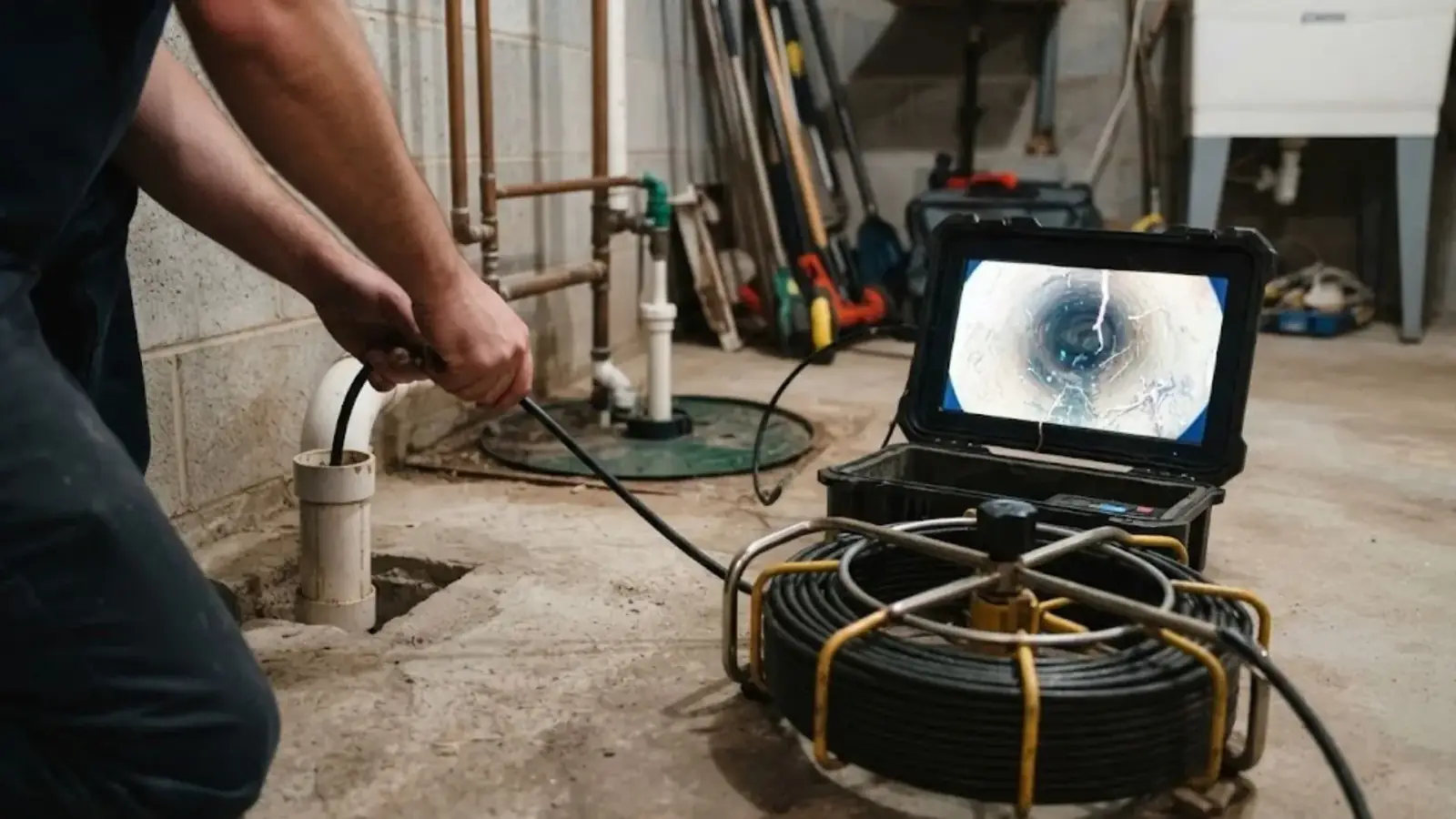
Most sewer inspections happen before a decision: a purchase, a repair, a relining or a stubborn backup that keeps returning. Because it is planned work, you pick a day, we agree on what you want to learn, and you leave with video and notes. If your drains are overflowing right now, skip this page and go to sewer line cleaning, which handles active backups.
Start with why you want the look
The reason for the inspection shapes how we do it and what we report. Someone buying a rowhouse wants a clear yes or no on the line. A landlord with three backups in a year wants a cause. An owner planning a liner needs a map of every bend and joint. The table below pairs common reasons with what you learn.
| Why you are looking | What the camera answers | What we note |
|---|---|---|
| Buying a home or rowhouse | Is the line intact from house to main | Cracks, offsets, roots, sags, material |
| Repeated backups | Is it a clog, a break or buildup | Where the problem sits, in feet from the cleanout |
| Before relining | Is the pipe continuous and cleanable | Bends, joints, diameter changes, damage |
| Wet yard or sunken ground | Is the lateral leaking | Location of the break, marked above ground |
| Rental or multi-unit building | Is the shared line sound | Condition by section, for the owner's records |
| After a cleaning or jetting | Did it remove the cause | Remaining buildup or damage |
What the camera actually sees
The camera head sits on a flexible push rod and carries its own lights. As it moves down the pipe, a monitor shows the interior in color. Cracks look like dark lines, roots look like fine hair or thick wads at joints, and a sag looks like a pool of standing water in a pipe that should drain. Grease and scale look like rough, uneven walls.
We enter through a cleanout when one exists. Without one, access may come through a pulled toilet or a roof vent, and that affects time and cost. Before we start, we ask about the history of the line so we know what to look for.
What we do not see
Inside a full line
A line packed with water or sewage blocks the view, so cleaning may need to come first.
Past a collapse
If the pipe has collapsed, the camera stops there and we cannot see beyond it.
Pipe ownership
The camera shows the pipe. Who owns which section is a question for the city or ACMUA.
Future failure
We report condition today. We do not predict when a sound pipe will fail.
Locating the problem above ground
Some inspection cameras carry a small transmitter at the camera head. A receiver at the surface picks up its signal, so we can mark the spot of a crack or sag on the ground and measure its depth. That turns a vague picture into a plan: how far from the house, how deep and what lies above it. Before anyone digs at a marked spot, call 811 so buried utilities are marked first.
Buying, relining or chasing a repeat backup? Call and tell us what you need to learn.
Call (609) 547-1417How an inspection day runs
- 1
Plan the visit
You tell us the reason, the building type and where the cleanout is, if you know.
- 2
Set up
We protect the floor, open the cleanout and check that the line is clear enough to see.
- 3
Run the camera
We push the camera through the line, narrating what we see and recording the video.
- 4
Locate
If we find a problem, we mark its location at the surface and note the depth.
- 5
Debrief
We go over the video with you, explain the findings and point out what looks sound and what does not.
What you get afterward
You receive the recorded video and written notes covering pipe material where visible, condition by section, the location of any defect and our plain-language read of what it means. If a repair looks warranted, we explain the options on our sewer line repair page. The video is yours to share with a lender, an insurer, a seller or another contractor.
We do not make the report longer than it needs to be, and we do not push a repair that the camera does not support. If the line looks sound, we say so.
Before or after cleaning
A clean line gives a better picture, so the camera is sometimes run after a pass with a cable or with hydro jetting. If the line is full of grease or debris, we will tell you whether to clear it first. The same logic applies to a stubborn single-fixture clog, covered under drain cleaning.
Older buildings, rentals and property managers
Atlantic City has many older multi-unit buildings, rentals and rowhouses. We do not claim pipe ages or percentages. We can say that a building with several units on one line shares its risk, and a recorded inspection gives a landlord or manager a dated record to compare against later. Owners just across the line in Ventnor City ask us the same questions.
What affects the cost of a sewer inspection
Access
A clean, reachable cleanout is quicker than a job that needs a fixture pulled.
Line length
A long run from a large building takes more time than a short residential lateral.
Locating
Marking and measuring a defect above ground adds time and equipment.
Pre-cleaning
A line that needs clearing first adds a separate cleaning step.
Report detail
A buyer's quick look differs from a full record for a multi-unit building.
An inspection is a diagnostic service, not a covered repair, and insurers differ on how they treat the findings. Ask yours before you submit a claim.
We quote a clear price before work starts. To plan an inspection, call (609) 547-1417.
Questions about sewer inspection in Atlantic City
It depends on the length of the line, the access and how clean the pipe is. A short residential line with a good cleanout is quicker than a long run with bends. We confirm the plan when you call, and we do not promise a fixed time.
It can show cracks, offsets and separated joints, and with a locator we mark where they sit. A leak in the surrounding soil is not directly visible, but a damaged section combined with a wet patch above is strong evidence.
It is a sensible step, especially for older homes and rowhouses where the sewer line is out of sight. Ask the seller about the cleanout, and contact the city or ACMUA about who owns which section. Inspections are planned, so book ahead of closing.
Yes. We provide video and written notes by section, which owners keep for their records. If a unit has repeated backups, a recorded inspection helps decide between cleaning and repair.
We clear it first, or tell you to. The camera needs a line it can pass through. Urgent backups are handled by our sewer line cleaning page, and we can schedule the inspection after flow is restored.
Yes. You receive the recording and notes, and you can share them with a seller, lender, insurer or another contractor.