
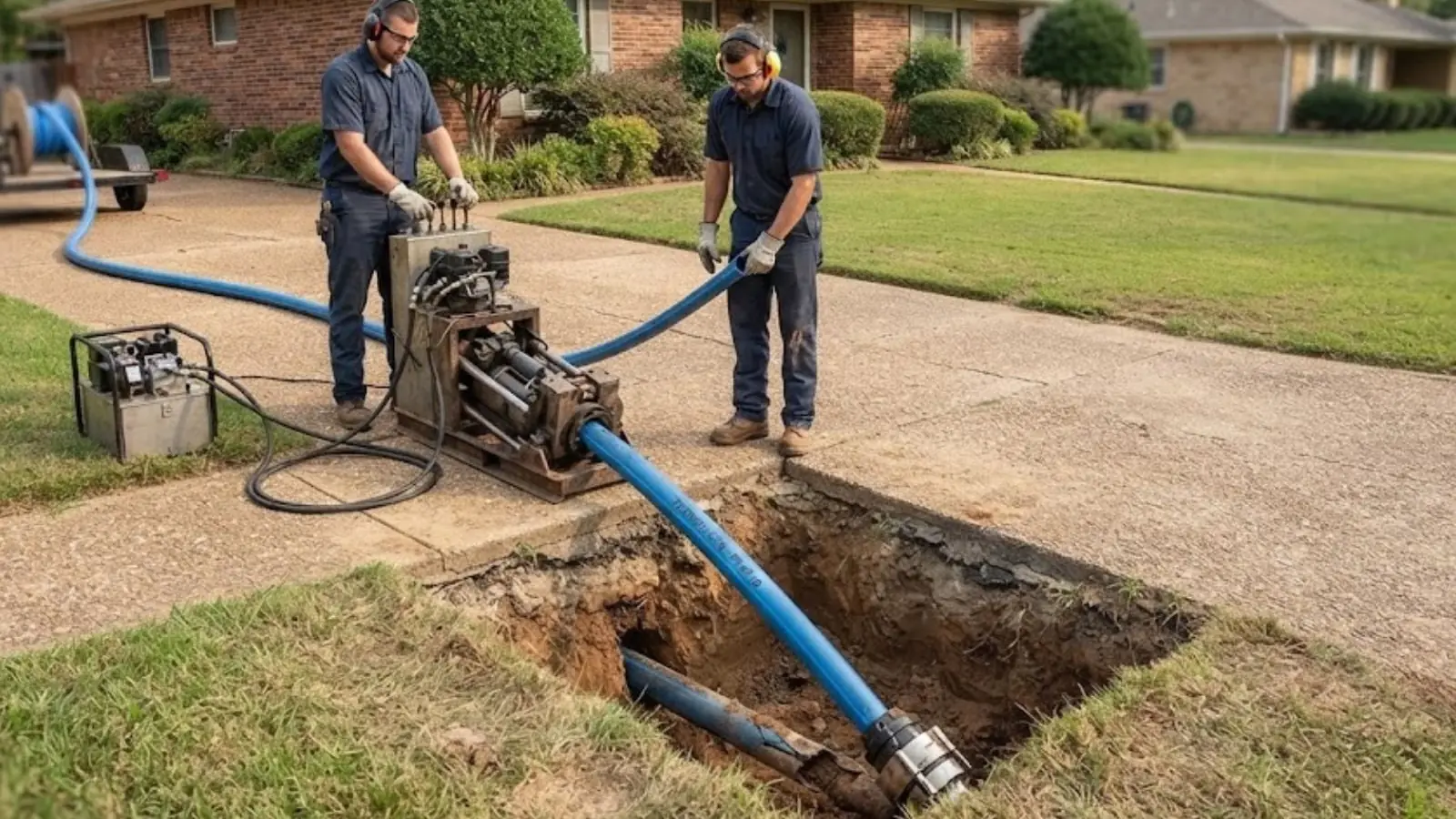
Lining or replacement: the decision in plain terms
A liner is a flexible tube soaked in resin. It is pulled or inflated into your existing pipe, pressed against the old walls and hardened in place, so you end up with a new pipe inside the old one. The old pipe has to be mostly in line and mostly round for that to work. If it is, lining can spare the lawn, the driveway or the basement slab.
If the pipe has dropped, collapsed or shifted apart, replacement is the honest answer. Our sewer line repair crews do both, and the choice is made from what the camera shows, not from which job is easier to sell.
| Question | Lining | Dig and replace |
|---|---|---|
| Digging needed | Small access points only | Trench along the full run |
| Works on cracks and open joints | Yes, if the pipe is still in line | Yes, and fixes alignment too |
| Works on a sagging section | No, the liner follows the sag | Yes, new grade can be set |
| Works on a collapsed pipe | Usually not | Yes |
| Root entry points | Sealed at joints along the lined length | Fewer joints in new pipe |
| Disruption to landscaping or floors | Low | High |
| Permit and inspection | Ask the construction office, rules vary | Ask the construction office, rules vary |
Why the camera comes first
No honest lining quote can be made blind. A sewer camera shows the pipe material, the diameter, where the cracks and roots are, and whether any section holds standing water. Without that picture, a contractor is guessing at both the method and the length of liner.
Ask for the recording, not a verbal summary. A sewer inspection should leave you with video or still images and a rough note on how many feet from the cleanout each problem sits. You can then compare quotes against the same evidence.
- Pipe material at the start of the run and anywhere it changes, such as clay, cast iron, or plastic.
- Pipe diameter along the full length, since a liner must be sized for it.
- Location of cracks, open joints, root masses and any offset where two pieces no longer line up.
- Any low spot where water stays put after the camera passes, which is called a belly.
- The point where your line meets the street connection, since the work must stay on the part of the line you own.
Call us to schedule a camera look before you decide between lining and digging.
Call (609) 547-1417How a liner is installed, step by step
The sequence on lining day
- 1
Clean the line
Cables or a jetter clear roots, scale and grease so the liner touches bare pipe wall, not debris.
- 2
Camera the cleaned pipe
A second look confirms the pipe is still in shape and the cracks are what the first pass showed.
- 3
Insert the resin sleeve
The liner goes in through a cleanout or a small access pit and is pushed along the old pipe.
- 4
Cure it
Hot water, steam or light hardens the resin so it forms a smooth new wall. Cure time depends on length and diameter.
- 5
Reopen the branches
A cutter reopens side connections so fixtures drain, then a final camera pass checks the finish.
Water use has to stop during curing, so expect to hold off on laundry, showers and flushing until the crew says the line is open. In a multi-unit building, that means telling neighbors that share the line.
When lining does not fit
There are honest reasons to say no to lining. A collapsed section has no round shape to press against. A large offset leaves a step the liner cannot smooth out, and a belly keeps holding water because the liner takes the same shape as the pipe around it.
Heavy bends, a sharp turn at the foundation, or a pipe that changes diameter without a clean transition can also rule it out. In those cases the better plan is a spot dig for the damaged section or a full replacement, which we would explain with the camera footage beside you.
Local note
Check where your side of the line ends
The Atlantic County Utilities Authority lists its wastewater treatment plant at 1801 Absecon Blvd in Atlantic City, but that tells you nothing about which agency owns the sewer main on your street. That has to be confirmed with the city or ACMUA at (609) 345-3315.
Make that call before you commit to any lining quote. A liner can only go inside the pipe you are responsible for, and the answer determines where the lined length starts and stops.
Questions to put to any contractor first
- Can I see the camera recording, with distances marked from the cleanout?
- Is my pipe round and in line enough for a liner, and how do you know?
- What happens to the branch connections, and how are they reopened?
- Which part of the line is mine, and have you confirmed that with the city or ACMUA?
- Is a permit or inspection needed here? The local construction office knows, since rules vary by job.
- Will you camera the pipe again after lining and give me that recording?
- What is the clear price before work starts, and what changes it if the camera finds something new?
Digging, 811 and the realistic edge cases
Even a liner job can need a small dig. If the line has no cleanout or the access point is in a bad spot, a pit is cut to reach it. Call 811 before anyone digs on your property, since buried gas, power and water lines are not marked on a homeowner's plan.
The cost of lining depends on the length, the diameter, how deep or tight the access is, whether cleaning takes more than one pass and whether the work is needed urgently. We give a clear price before work starts. If it is an active backup, our sewer line cleaning page covers what we do first to get drains moving again.
Lining is a repair, not a replacement for good habits. Keep wipes, grease and flushable-labeled products out of the drain and avoid planting trees directly over the line. We also serve Ventnor City and Absecon, and a camera inspection is how any of these lines gets diagnosed.
Quick answers
It depends on what the camera shows. If the pipe is round and in line but cracked or root-invaded, lining is often a good fit and spares digging. If the pipe has collapsed, dropped or pulled apart, replacement is the right call.
Yes. The camera shows the material, the diameter, the damage and any belly in the line. A lining quote made without it is guesswork, and a bad guess can leave you paying twice.
No. The liner follows the shape of the old pipe, so a low spot keeps holding water. A section with a belly needs to be dug and re-graded.
Water use stops while the resin cures and until the crew confirms the line is open. The length of the wait depends on the run and the pipe size, so ask for it when the job is scoped.
That depends on the street and the connection, and we do not assume it. Confirm with the city or ACMUA at (609) 345-3315 before approving any lining, since a liner can only go inside the part of the pipe you are responsible for.
It varies by job and by municipality. New Jersey's Uniform Construction Code applies to plumbing work and your local construction office decides what is needed, so ask them before the job is scheduled.