
Why water behaves differently on this island
Atlantic City sits at about 7 feet of elevation on Absecon Island, with the ocean on one side and back-bay water on the other. The National Weather Service in Mount Holly sets tidal flood levels at the Atlantic City gauge, measured in feet MLLW. Those thresholds are a useful yardstick for deciding how hard your pump will be asked to work.
| Gauge reading | NWS description | What to do with your pump |
|---|---|---|
| At 6.0 ft | Minor tidal flooding | Check that the float moves freely and the discharge line is clear |
| At 7.0 ft | Moderate, widespread roadway flooding | Test the pump and the backup battery, and clear the pit of debris |
| At 8.0 ft | Major, structural damage possible | Expect long runtimes, keep a second pump or backup ready, and stay out of flooded rooms |
A Rutgers study from 2019 projects 17 to 75 days per year of high-tide flooding by 2030, compared with less than once a year in 1950. For a homeowner, that means a pump is no longer an occasional storm tool. It may run on ordinary high tides, so it needs to be sized, powered and tested like equipment that gets used.
We do not assume what is below your building. Buildings differ: it might be a basement, a crawlspace, a low utility room or garage, or none of these. A sump pump belongs only where water actually collects, which a plumber confirms on site.
Sump pit or sewage ejector
These two get mixed up often. A sump pit collects clear groundwater or seepage and sends it outside. A sewage ejector pit collects wastewater from a below-grade bathroom, laundry or floor drain and lifts it up to the sewer line. They use different pumps, different covers and different venting.
| Feature | Sump pump | Sewage ejector |
|---|---|---|
| What it handles | Groundwater and seepage | Toilet, sink and laundry wastewater |
| Where it discharges | Outdoors, away from the foundation | To the building's sewer line |
| Pit cover | Loose or vented lid | Sealed and vented to the roof or stack |
| Solids | Small grit only | Passes solids per the pump rating |
| Needs a plumber | For discharge and check valve work | Yes, with code-compliant venting |
Never send toilet water to a sump pit, and never run a sump pump discharge into a sewer line without asking first. If you are unsure which you have, our sump pump repair page explains the failures we see, and a plumber can read the setup on a short visit.
Tell us what the low spot looks like, and we will tell you which pit it needs.
Call (609) 547-1417What a sump pump installation actually involves
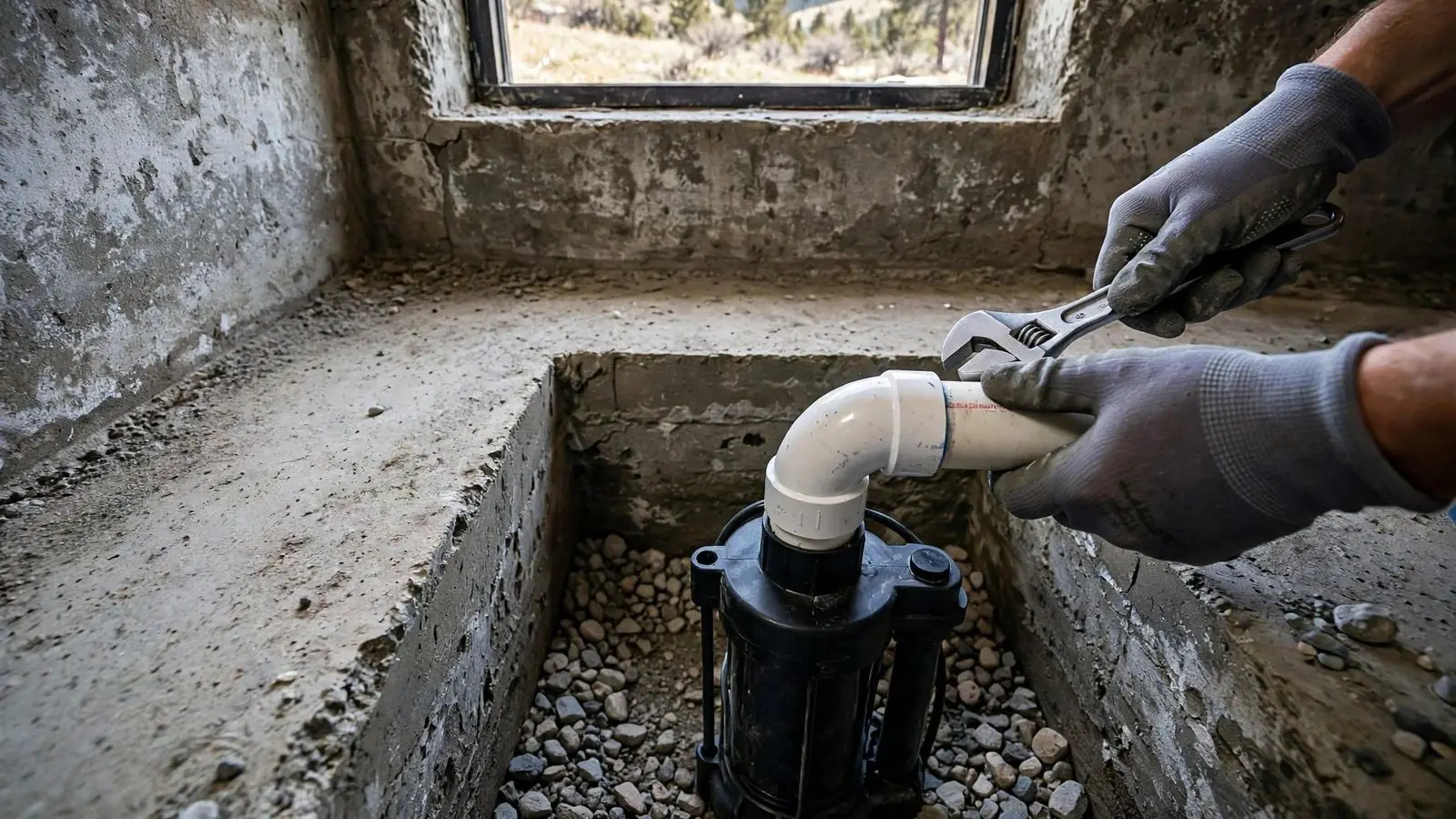
From dry floor to working pit
- 1
Choose the low point
The pit goes where water naturally collects, not where it is easiest to dig.
- 2
Open the floor
A section of slab is cut, soil removed, and a basin set so its rim sits flush with the floor.
- 3
Set the pump
The pump sits on a stable base in the basin with the float clear of the walls and discharge pipe.
- 4
Add a check valve
A check valve in the discharge line stops pumped water from falling back into the pit.
- 5
Run the discharge
The pipe goes outdoors to a spot that sheds water away from foundations and neighbors.
- 6
Test under load
Water is poured into the pit until the float lifts and the pump clears it, then the cycle is repeated.
Battery backup and storm-night power
The worst nights for flooding are often the nights the power flickers. A pump that stops when Atlantic City Electric goes out is not much of a defense. A battery backup pump, or a battery system that takes over the primary pump, keeps water moving during an outage.
Batteries need attention. Check the charger light, test the pump every few months, and replace the battery on the schedule its maker gives. A backup that has not been tested is a hope, not a plan.
Local note
What past storms tell you about the pit
Hurricane Sandy peaked at 8.8 ft at the Atlantic City gauge on October 29, 2012, above the 8.0 ft major flood level. New Jersey figures cited in news coverage say 9 percent of Atlantic City homes were seriously damaged, and that streets in Chelsea Heights still flood often.
The same coverage notes that water can rise through storm sewers during full-moon high tides and storms. A sump pump cannot stop that, because it only handles water that reaches your pit. Treat it as one layer, alongside raising stored items and knowing where your shutoffs are.
Where the discharge can go
Discharge rules differ from one municipality to the next, so ask your local construction office and, for sewer questions, ACMUA at (609) 345-3315 before the pipe is run. Many places do not allow groundwater to enter the sanitary sewer, and some limit discharge across sidewalks or onto neighboring property.
Whatever the rules say, a few practical points hold. Point the outlet away from the foundation, keep it above the level where storm water backs up, and avoid pipe runs that can freeze and block. Outlets that end near a storm drain can fill backwards when the drain is full, so ask what happens at a high tide.
- Confirm that the spot you want to protect really collects water, rather than assuming it does.
- Ask the local construction office what permit or inspection applies to a new pump and discharge.
- Call 811 before digging a trench for a buried discharge line.
- Have the pit sized for your pump with room for the float to swing freely.
- Keep electrical outlets for the pump on a ground-fault circuit and off the floor.
- Turn the power off at the breaker before touching any wet equipment, and stay out of standing water that may be near live wiring.
Where installation fits among our other plumbing work
A new pit is planned work, so we schedule it with a clear price before work starts. If your pump has already stopped during a storm, the repair page is the right starting point. Larger projects that add a bathroom below grade belong under plumbing installation, because the ejector, venting and waste lines have to be designed together.
We serve homeowners in Galloway Township and Egg Harbor Township, and a pit plan always starts with the same question of where the water collects on that particular property.
Quick answers
Only if water collects where you can't keep it dry. We do not assume homes here have basements, and many do not. A plumber should confirm the low spot, the water source and whether a pump, a drain or a grading fix is the right answer.
A sump pump moves groundwater and seepage outdoors. A sewage ejector lifts wastewater from a below-grade bathroom or laundry to the sewer line. They use different pits, pumps and venting, and should never be swapped.
On an island that floods during storms, usually yes. Storms are also when power fails, so a pump without backup can stop at the worst time. The battery must be tested and replaced on schedule to be of any use.
Rules vary by municipality and by situation. Ask your local construction office, and ask ACMUA about anything touching the sewer. Do not connect to the sanitary sewer without approval, and point the outlet away from your foundation and neighbors.
Pour water into the pit every few months and before storm season, and watch the float lift and the pump clear it. In Atlantic City, check it again before a forecast high tide or a coastal storm.
It can. New Jersey's Uniform Construction Code governs plumbing work and your local construction official enforces it, but which jobs need permits varies. Call the office before work begins and tell us what they say.